
Miao Song Collection around Kunming
The Miao people have undergone extensive migrations throughout history, forming distinct groups based on dialects—Xiangxi (湘西), Qiandong (黔东), and Sichuan-Guizhou-Yunnan (川黔滇)—across multiple Chinese provinces. These migrations have led to unique cultural traits within each group, as seen in their ancient songs, or “Miao Epics”. The efforts to systematically collect, organise, and study these Miao songs have been vigorously pursued. This includes initiatives to nominate them for national intangible cultural heritage status and the compilation of regional anthologies of Miao songs. Existing research on Miao songs primarily focuses on Miao-populated areas like Guizhou Province and West Hunan Province, often overlooking the Miao musical landscape in Yunnan.
In light of the limited collection and circulation of ancient Miao songs in the Kunming area, the ECura project team aims to systematically collect and study the region’s ancient Miao songs, a critical but under-researched aspect of local intangible cultural heritage. Based on initial investigations, the ECura project team plans to collect these songs in collaboration with local Miao communities around Kunming.

Collecting and digitalizing the long narrative song
This is a long narrative song, Hongzhao and Raojue Xina 红昭和饶觉席那), with a distinct anti-feudal theme, primarily circulated in Yunnan and other regions. It is a rare example of Miao folklore literature in Yunnan. The story depicts the heroic struggle of the protagonists, Hongzhao and Raojue Xina, against the emperor’s forces, which symbolize the feudal ruling class. This epic demonstrates the Miao people’s spirit of resistance and triumph over feudal oppression and also delves into the love story between the protagonists.
The song was first published in 1957 by the China Youth Publishing Press (中国青年出版社), collected and edited by Rugerful Zameng (鲁格夫尔·扎猛) and Xinfeng Lu (陆新风), with Cheng Zhou (周诚) and Yi Hong (弘毅) as the writers. Then, it was translated into Chinese and its ancient song scores were formalized by Miao scholars such as Shaohu Tao (陶绍虎) and Shiwu Yang (杨世武) in 2012, followed by its official publication. According to the local news reports from October 2014 reveal that Miao singer Xinxiao Yang (杨新秀) from Fumin County (富民县) performed the ancient Miao song Hongzhao and Raojue Xina for the first time at the Kunming Theatre, alongside the Xiaoshuijing Miao Farmers’ Choir. In 2017, the cultural inheritor Hanzhe Wang (王汉哲) successfully declared it as a provincial intangible cultural heritage. ECura plans to establish contact with the individuals associated with this epic song to further discuss the digitalization of its text, audio, and visual content.
Connecting with the authors of Ancient Miao Songs of the West
The collection of Ancient Miao Songs of the West (西部苗族古老歌) was gathered by Yuxiang Zhu (朱玉祥), Zhonglun Yang (杨忠伦), Shiwu Yang (杨世武), and Guanglong Zhu (朱光龙), who interviews with hundreds of Miao folk artists, collecting and organizing musical materials from the Northeastern Yunnan dialect group of the Miao music. Notably, the Miao communities around Kunming belong to this Northeastern Yunnan dialect area. This song’s audio collection is included in the Chinese Music Net Intangible Heritage Library: 人类口头和非物质文化遗产专题库 – 中华传统音乐数字文献图书馆 (china1901.com). Unfortunately, the audio does not provide detailed information on the performers and their performed songs. ECura plans to discuss with relevant individuals about the enhancement of digital content, including text, audio, and video, for this collection.

ECura’s Collaboration with Xiaohai Xin Village (小海新村)
ECura Signed Cooperation Agreements with Community Leaders in Xiaohai Xin Village
The villagers of Xiaohai Xin Village possess a profound passion for music and dance, reflected in the existence of many performing arts groups. The village’s music and dance are rich and varied, with the older generation primarily preserving the Miao’s traditional songs, such as ancient tunes, flying songs, and Lusheng (mouth organ) tunes. On the other hand, the younger villagers show a preference for modern innovation, enthusiastically embracing newly composed and original Miao songs and dances, as well as contemporary popular music.
In February 2024, researcher Keyi Liu, representing the ECura project team, signed a cooperation agreement with two community leaders, Hongming Zhang (张洪明) and Haiyan Long (龙海燕), in Xiaohai Xin Village to jointly promote the inheritance of Miao’s traditional music culture. The aims of this cooperation are to record the ancient Miao songs passed down by the village elders and to provide support for the younger generation’s new adaptations and creations of Miao music and dance. Additionally, the cooperation intends to use online media platforms to transform these daily music-related activities into digital content for wider dissemination, with the goal of promoting broader recognition and appreciation of Miao music and dance in modern society.
2024年2月,研究员刘可意作为ECura项目的代表,在小海新村与两位社区负责人张洪明和龙海燕签署了共同推进苗族传统音乐文化传承的合作协议。刘可意在田野中参与和观察了小海新村村民们日常的音乐和舞蹈活动,并详细了解了村民们在发展该领域的具体需求。此次合作的目的,一是记录村里老一辈人传承下来的苗族古歌;并根据青年一代改编和创作苗族音乐的需求提供相应的帮助。二是利用线上媒体平台将村民们日常生活中与音乐相关的活动转化为数字内容进行传播,增强公众对苗族音乐与舞蹈的认知与欣赏。

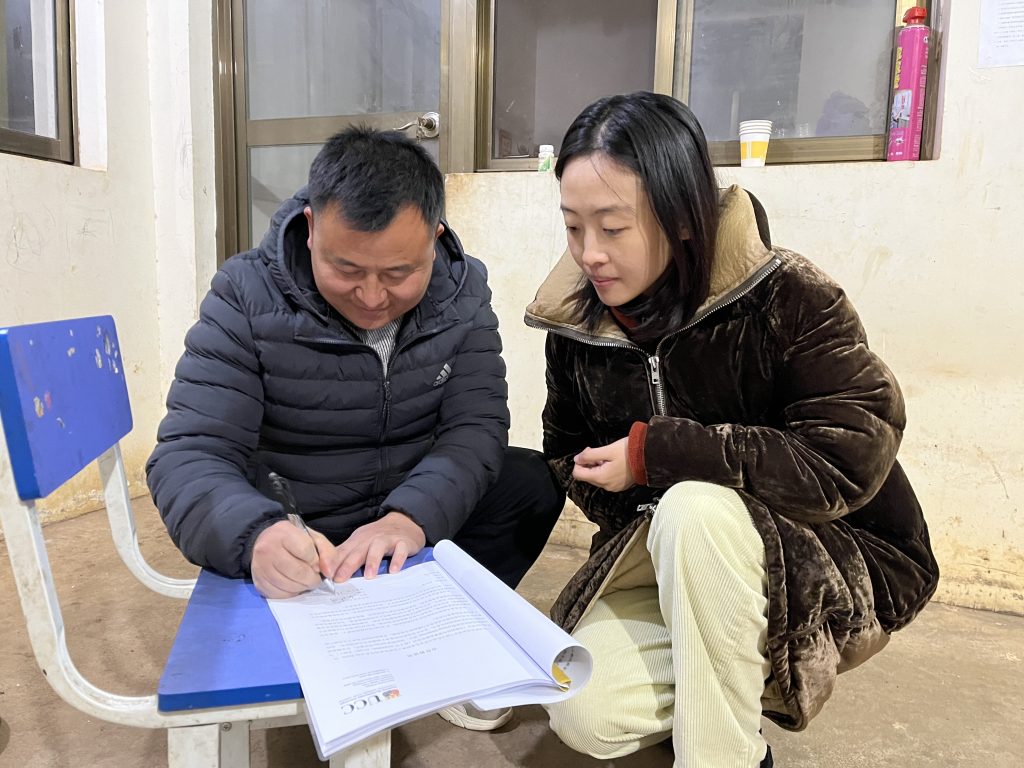
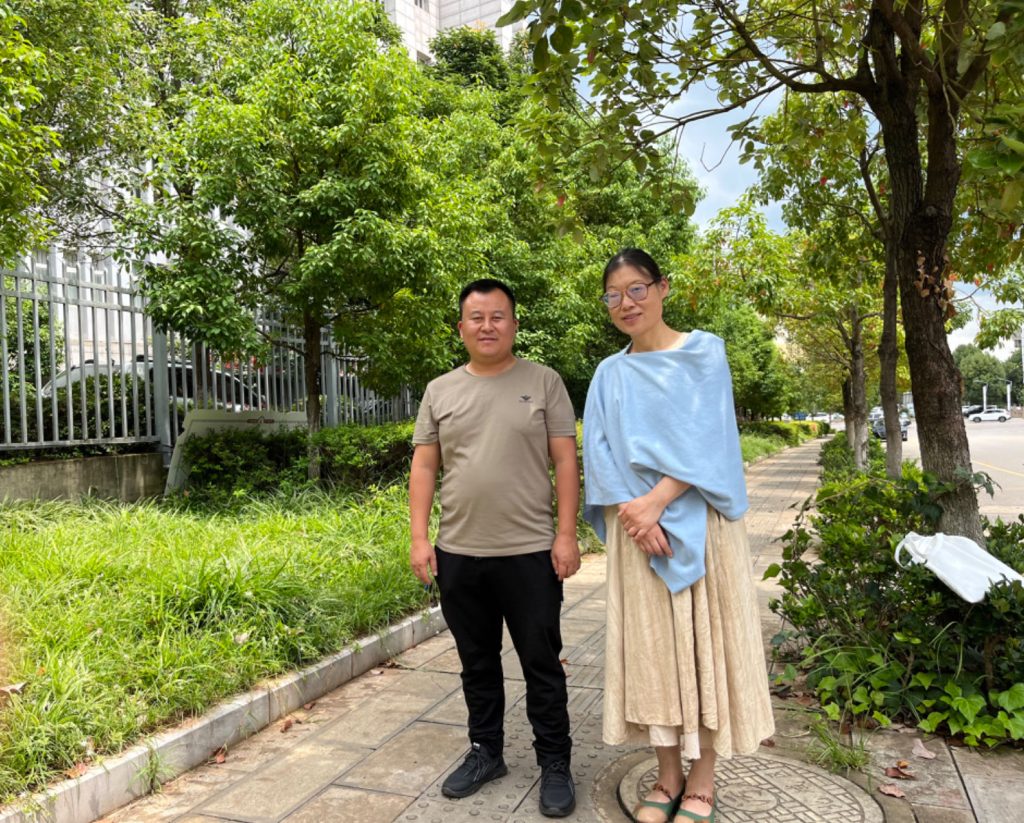
ECura’s Meeting with Miao Community Leader Hongming Zhang for Collaboration
Principal Investigator of the ECura project team, Dr. Lijuan Qian, conducted fieldwork in Yunnan in July 2024. During her fieldwork, she visited Hongming Zhang and inquired about the development needs of the Miao community regarding the preservation of traditional music. During the meeting, Hongming Zhang expressed his desire to learn how to create musical scores using MIDI software for multi-instrument compositions, with the support of ECura’s academic guidance. Additionally, he showed interest in learning piano tuning to ensure that the villagers’ instruments are well-maintained for their musical activities. Furthermore, Hongming Zhang highlighted the rich collection of epic stories within the Miao community that await exploration. Lijuan Qian agreed to begin preparing for these initiatives and proposed collaboration between ECura and the Miao community to enhance their musical capabilities with modern techniques.
ECura 项目团队首席研究员钱丽娟博士于2024年7月在云南进行了实地调研。调研期间,她拜访了苗族社区负责人张洪明,并问询了苗族社区的关于传统音乐保护方面的发展需求。在会谈中,张洪明表达了他希望在 ECura 的学术指导下,学习使用 MIDI 软件为多乐器编曲的愿望。此外,他还对学习钢琴调音表现出了兴趣,以确保村民们的乐器在音乐活动中得到良好的维护。此外,张洪明还强调了苗族社区丰富的史诗故事,这些故事有待进一步发掘。钱丽娟同意为这些计划做准备并将提供技术支持。
ECura’s Meeting with Miao Community Leader Hongming Zhang
On September 23rd 2024, research assistant Yalun Yang, representing the ECura project team, visited Xundian County in Kunming City to meet with Hongming Zhang, the community leader of the Miao Xiaohai Xin Village. The meeting focused on resolving two key issues: project payment processes and music production support.
Yalun assisted Hongming in setting up online banking to address a payment issue with service fees from University College Cork (UCC). This enabled efficient online management of project funds and streamlined financial processes. To support Hongming’s music production needs, Yalun recommended and installed EOP NMN Master, a free music notation software, providing on-site training. Given his interest in music arrangement, she also demonstrated how to use GarageBand for track design and instrument layering. Yalun is further exploring Windows-based alternatives to support his work effectively. Hongming expressed that the collaboration with the ECura project greatly supports the community’s cultural heritage and musical development.
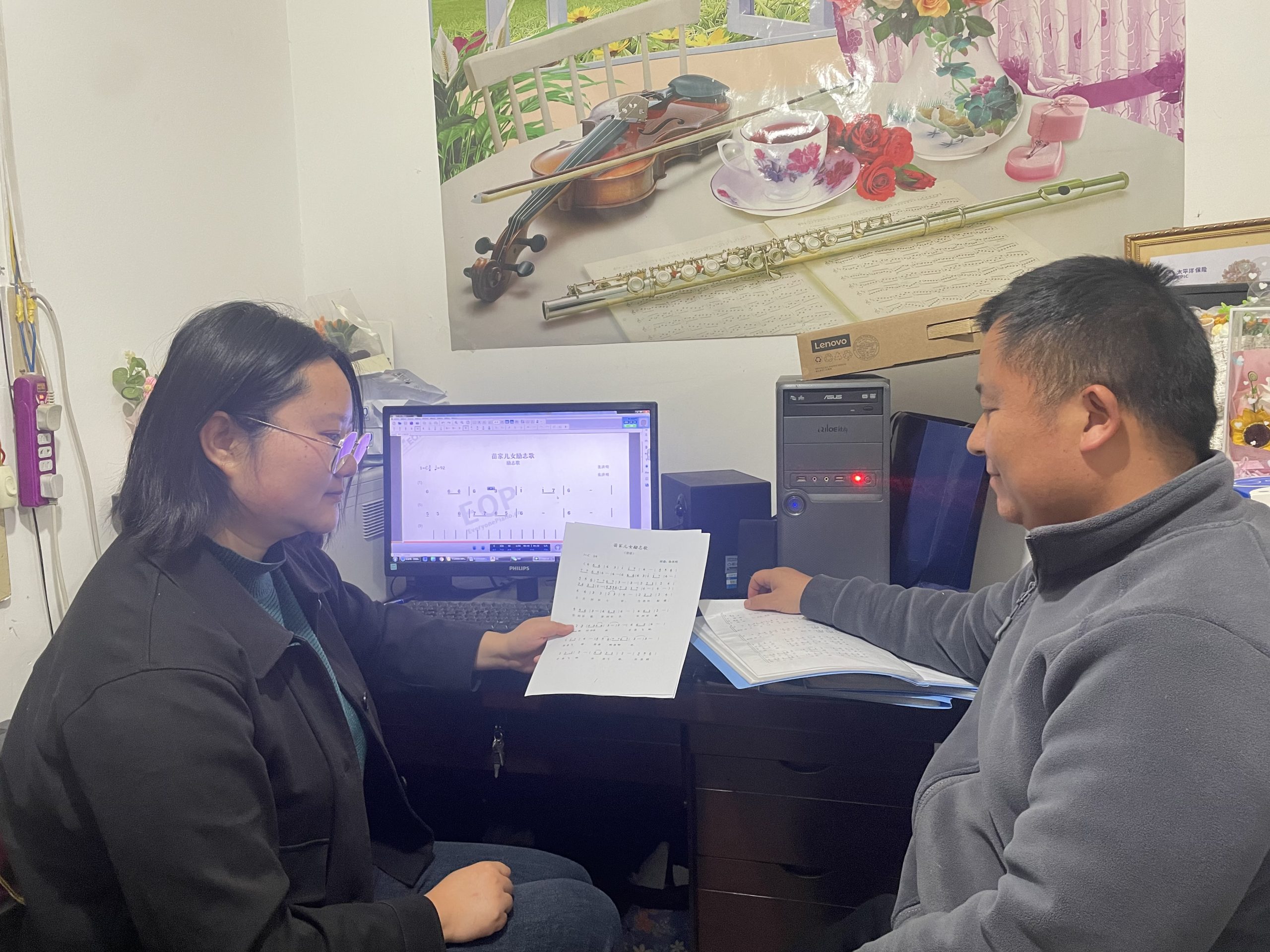
2024年9月23日,ECura项目研究助理杨雅伦前往昆明市寻甸县,与苗族小海新村的社区领袖张洪明会面,重点解决了项目支付和音乐制作支持方面的问题。杨雅伦首先协助洪明开通了网上银行,以解决与爱尔兰科克大学(UCC)劳务费支付相关的问题,使张洪明能够在线高效管理项目资金,简化财务流程。另外,为支持张洪明的音乐制作需求,杨雅伦推荐并安装了免费的制谱软件EOP NMN Master,并提供了现场培训。鉴于洪明对编曲的兴趣,她还演示了如何使用GarageBand进行音轨设计和乐器分层。杨雅伦也将继续寻找适用于Windows系统的替代方案,以更好地支持洪明的音乐创作。张洪明与ECura项目的合作对苗族社区的文化传承和音乐发展提供了极大的支持。

Meeting with Zhang Hongming
The ECura Project Assistant Yalun Yang revisited Miao musician Hongming Zhang in Xundian County, Kunming City, on 10th-11th March 2025 to establish the progress of his musical activities and to agree on further collaboration. Mr. Zhang took time from his busy schedule to show Yalun his electronic software to create a short score. Since Yalun’s last visit to Mr Zhang and the software installation, Mr. Zhang has successfully used the software to transcribe his composed songs into simplified notation scores, providing more convenience for his future music teaching and promotion. After that, Mr. Zhang showed Yalun 19 Miao songs composed by Mr. Zhang. Yalun will help him to arrange the pentatonic scores in the future.
ECura项目助理杨雅伦于2025年3月10日至11日再度于昆明市寻甸县拜访了苗族音乐家张洪明,确立了他的音乐活动进展并商定后续合作内容。张先生百忙之中抽空为雅伦展示了自己用电子软件制作的简谱,自从上次雅伦拜访张先生并为他安装了软件之后张先生成功用软件将自己创作的歌曲转录成了简谱,这将为他以后的音乐教学和宣传提供更多的便利。之后,雅伦认真记录了张先生创作的19首苗族歌曲,并将在后续的时间里对他的五线谱录制以及编曲进行帮助。
Music Analysis of Song of Creating All Things 创造天地万物歌
Song of Creating All Things belongs to category of Miao epic songs that describing how the gods creating the whole world. Interpretated the value and the world ideology of Miao people. In this song, two gods, lieb ndlas shib trub git myut and yuel jox dlangb hnub created sky, earth, clouds, rivers, mountains, valleys, etc. People cherish their contribution, so remembered them by rituals such as toasting wine to the bottom of stones and offering chicken’s feet to the tree’s roots.
Mode
The melody centres on D as its tonal core, frequently returning to this pitch at both phrase beginnings and endings. The pitch material is largely confined to D, E, G, and B, forming a tetratonic scale that may be regarded as a reduction of the D gong (宫) mode within the Chinese pentatonic system. In performance practice, however, the precise intonation of pitches often varies according to the singer’s vocal range and individual style.
Audio Recording of Song of Creating All Things 创造天地万物歌:
Melodic features
The melodic shows one of the characters of Miao songs, which the melodies always vary from one certain type of melodic features, so each phrase ended perfectly, and could be sing along separately. In this song, I analyzed three basic melody types which most represented for short sentence, middle sentence and long sentence, which are also the first three phrase of this song.
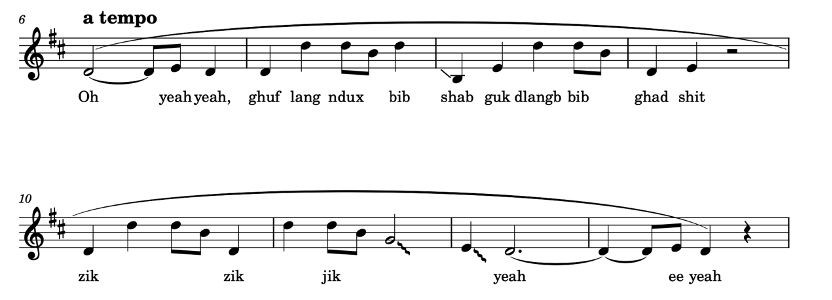
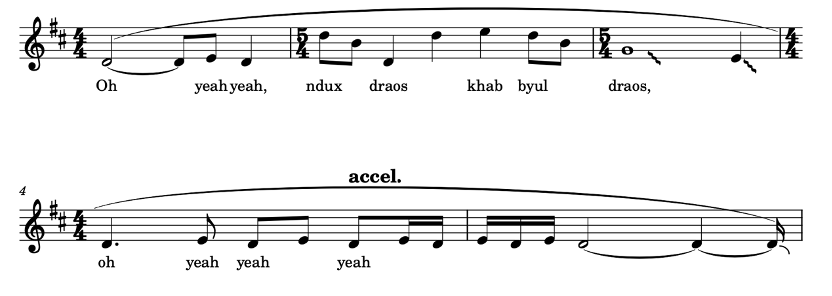
All three melodic types of the ancient Miao songs all revolve around a core set of four pitches: D, E, G, and B. A characteristic feature is the frequent occurrence of an octave leap from D at the beginning of a phrase. Following this opening gesture, which I have marked in red (See Ex 1.), the melody gradually returns to D, either by stepwise or descending leap. Within this process, B and G usually function as passing tones in the downward motion from D, appearing primarily in the context of descending leaps. The D–B–G motion forms a recurrent descending framework that ultimately resolves back to D. The pitch E may or may not be involved in this descent, when included, it generates a stepwise figure of D–B–G–E–D, and when omitted, the descent retains the more concise structure of D–B–G–D.
Ex. 1 Octave leaps in the song
Rhythm
In performance practice, the rhythm is flexible, following the natural flow of the text rather than strict metrical rules. Such free rhythm presents challenges for transcription. In standard Western notation, musicians or scholars often fails to capture the fluid tempo of oral singing, and have to reliance on audio recordings for accuracy.
In my transcription, I use shifting meters such as 5/4, 4/4, and 6/4. These time signatures do not suggest that the song strictly follows such patterns, but rather function as a compromise between the regulation of Western notation and the flexible rhythm of live performance. By adopting changing meters, the notation seeks to approximate the song’s natural flow, at the same time, retaining readability for performers and researchers.
In this song, a clear rhythmic distinction shows between the main body of the phrase and its vocables. The body part of each phrase, including their initial vocables, maintain a stable rhythm, most often articulated through quarter notes and sixteenth notes. By contrast, phrase endings feature the improvised repetition of “Oh yeah yeah yeah yeah”, sung with descending slides, which introduces a freer rhythmic quality. Each phrase is relatively independent, often separated by short pauses. In longer phrases, singers may also insert a breath at the midpoint, represented the flexible, orally grounded organization of rhythm in this tradition.
Vocal Style and Ornamentation
At the beginning of each phrase, singers typically introduce a vocable such as “Oh yeah yeah”, which functions as a vocal marker represent the start of the phrase. At the end of each phrase, the same vocable is often sung again, this time with a descending slide as “Oh yeah yeah yeah yeah” (See Ex.2). The number of repetitions at the end is not fixed but rather carries an improvisatory quality, depending on the individual singer’s preference. This technique of framing phrases with matching vocables at both the opening and the closing creates a sense of relative independence for each phrase, while also giving the performance a distinctive stylistic identity. In addition, when executing the octave descent, singers frequently using a descending sliding technique before the lower note of the octave, further enriching the expressive character of the melody.
Ex.2 Phrase structure of the song
Conclusion
The Song of Creating All Things reveals the essential qualities of Miao ancient songs, which is a free rhythmic structure shaped by the flow of the lyrics, a melodic framework centered on D with recurring octave leaps and descending gestures, and the pervasive use of vocables at phrase openings and endings. Rather than adhering to strict metric regularity, the song’s rhythm is guided by the delivery of words and the expressive choices of the singer. This relationship between text and melody, reinforced by improvisatory ornaments, highlights the oral and performative nature of the tradition. In this way, the song exemplifies how Miao ancient songs situate musical expression within the primacy of language and storytelling, allowing rhythm and melody to serve the unfolding of the text.
Credit: Lijuan Qian (13 October 2025).
Miao New Year Celebration Song Recorded in Zhaotong, Yunnan
Lyric excerpt: “Today is a good year, good month, good time / We welcome guests from all directions / We have nothing to offer you / Only a cup of fine wine raised to you — A Wu Yi Lou!”
歌词大意:今天好年好月好时光,喜迎四方宾客,没有什么敬给你们,唯有一杯美酒敬给你,阿乌义喽!
This video was recorded in a restaurant in Zhaotong, Yunnan, on 17 January 2026, during the Miao New Year celebration
From Sound to Score: The ECura Project’s Collaboration with Miao musician Zhang Hongming
The ECura Project’s research assistant, Yalun Yang, collaborated with Miao musician Zhang Hongming to transcribe his original compositions into staff notation. Below is a list of his 19 original musical works:
| 1 | 迎宾曲 “Welcoming Song” |
| 2 | 喜迎花山节 “Joyous Celebration of the Flower Mountain Festival” |
| 3 | 留恋 “Nostalgia” |
| 4 | 相聚是缘 “Meeting Is Fate” |
| 5 | 迎新郎新娘歌 “Song for Welcoming the Bride and Groom” |
| 6 | 阿哥阿妹 “Brother and Sister-Young Lovers” |
| 7 | 好歌献给新郎新娘 “A Beautiful Song for the Bride and Groom” |
| 8 | 草子地欢迎你 “Caozidi Welcomes You” |
| 9 | 朋友分别歌 “Song of Farewell Between Friends” |
| 10 | 寻甸欢迎你 “Xundian Welcomes You” |
| 11 | 挽留歌 “Song of Persuasion to Stay” |
| 12 | 一天不见隔三秋 “A Day Apart Feels Like Three Autumns” |
| 13 | 情歌对唱 “Love Song Duet” |
| 14 | 思念 “Missing You” |
| 15 | 北京我爱你 “Beijing, I Love You” |
| 16 | 你是我心中的最爱 “You Are the Love of My Heart” |
| 17 | 欢乐苗寨 “Joyful Miao Village” |
| 18 | 感动感谢谢谢你 “Touched, Grateful, Thank You” |
| 19 | 再见吧宝贝 “Goodbye, My Darling” |
Transcription Examples:
Joyous Celebration of the Flower Mountain Festival 喜迎花山节
Brother and Sister-Young Lovers 阿哥阿妹
A Beautiful Song for the Bride and Groom 好歌献给新郎新娘
Joyful Miao Village 欢乐苗寨
ECura Project Team Meets Miao Community Collaborators in Xiaohai Xin Village
On 6 February 2026, Dr. Tingting Tang, Postdoctoral Researcher with the ECura project, and Yalun Yang, a PhD student in Ethnomusicology at University College Cork, held an informal meeting in Kunming, Yunnan Province, with Long Haiyan (龙海燕), a Miao community collaborator of the project.
During the meeting, Dr. Tang (who officially joined ECura in September 2025) introduced herself, the main project team members, and recent project priorities. Long Haiyan warmly reflected on her collaboration with ECura, particularly with the project’s Principal Investigator, Dr. Lijuan Qian. She expressed her gratitude and hoped for more opportunities under ECura’s support to carry out activities that benefit the cultural heritage of her community.
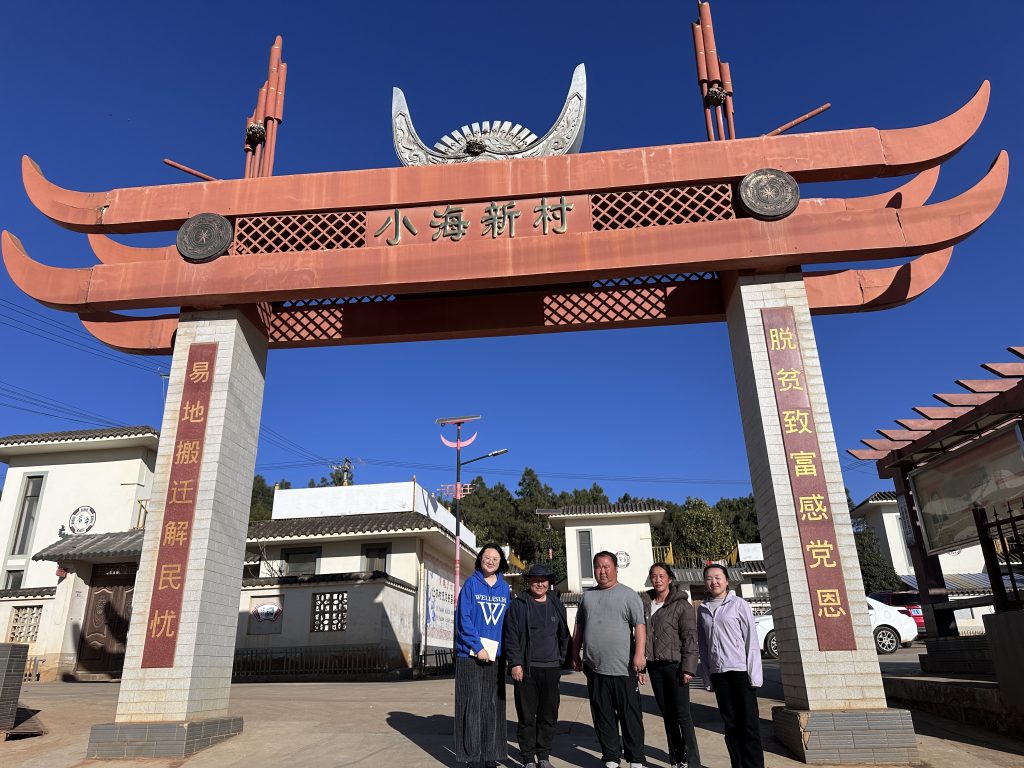
(Photo by Tingting Tang)
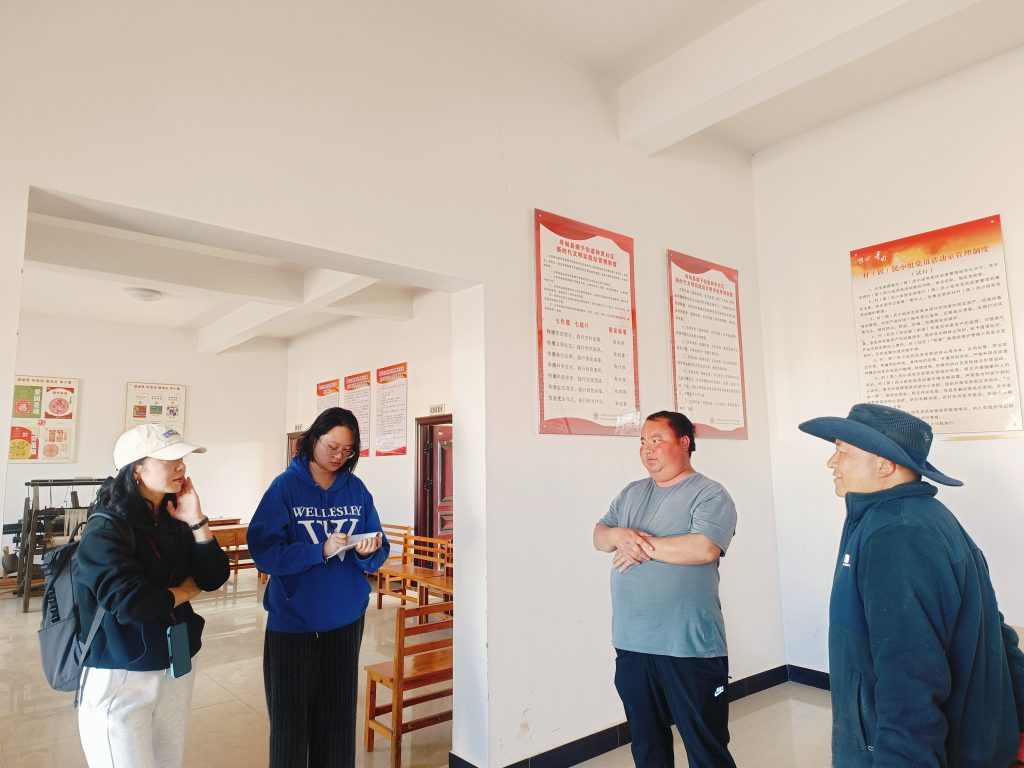
Dr. Tang subsequently invited Long Haiyan to join the project team’s fieldwork in Xiaohai Xin Village, assisting with interviews and mini‑program promotion over a three‑day period. Long Haiyan offered to coordinate with local folk artists and intangible cultural heritage bearers, while the project team took charge of scheduling and transportation. After four days of preparation, the three departed from Kunming on 11 February 2026, arrived in Xiaohai Xin Village, Xundian County, and successfully completed three days of highly productive fieldwork.
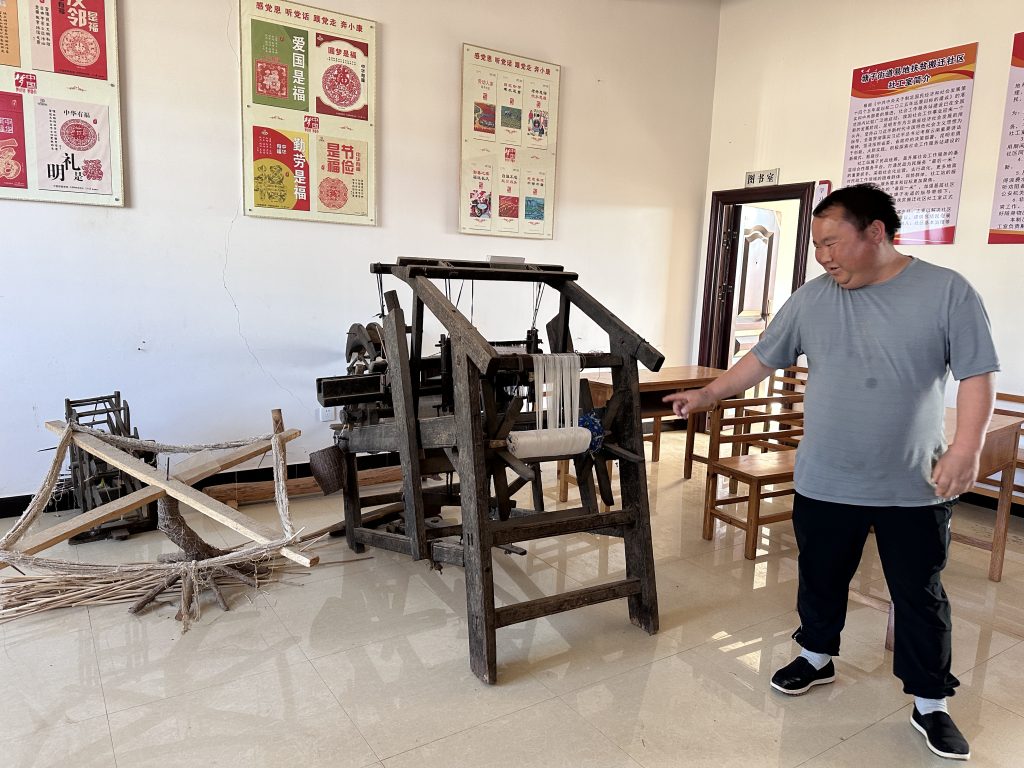
On 11 February 2026, the village head of Xiaohaixin Village and Miao community collaborator and musician Zhang Hongming (张洪明) guided the project team through the village committee office, the intangible cultural heritage exhibition room, and provided a detailed introduction to the village’s relocation history, cultural activities, and the transmission of local folk traditions.
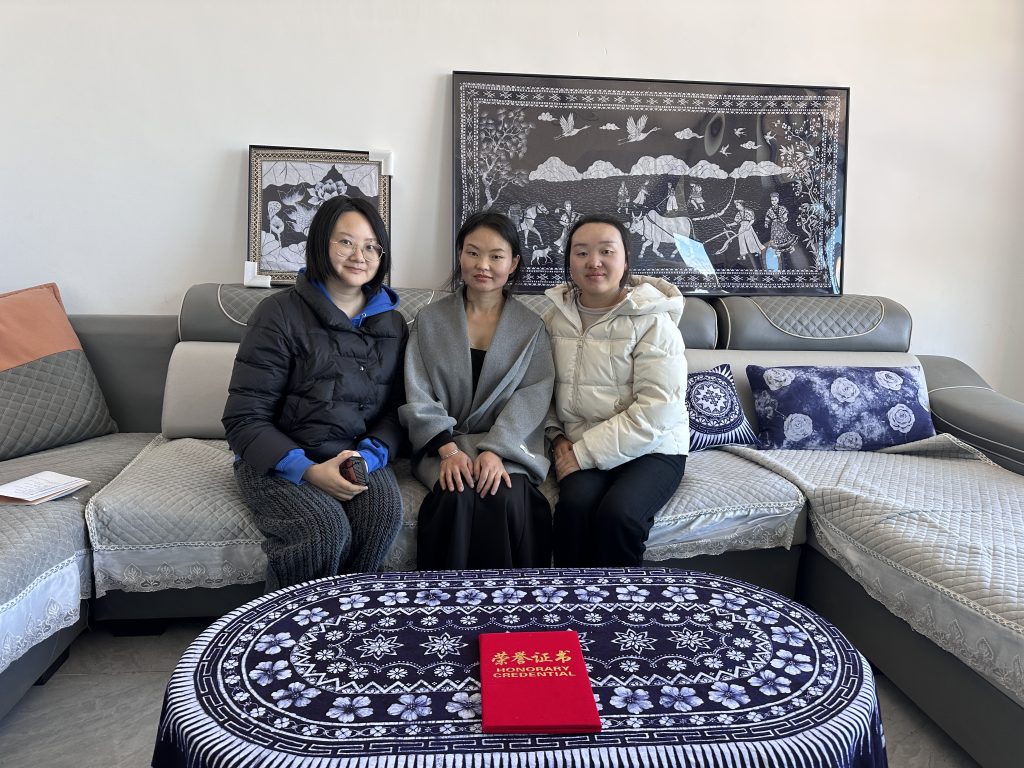
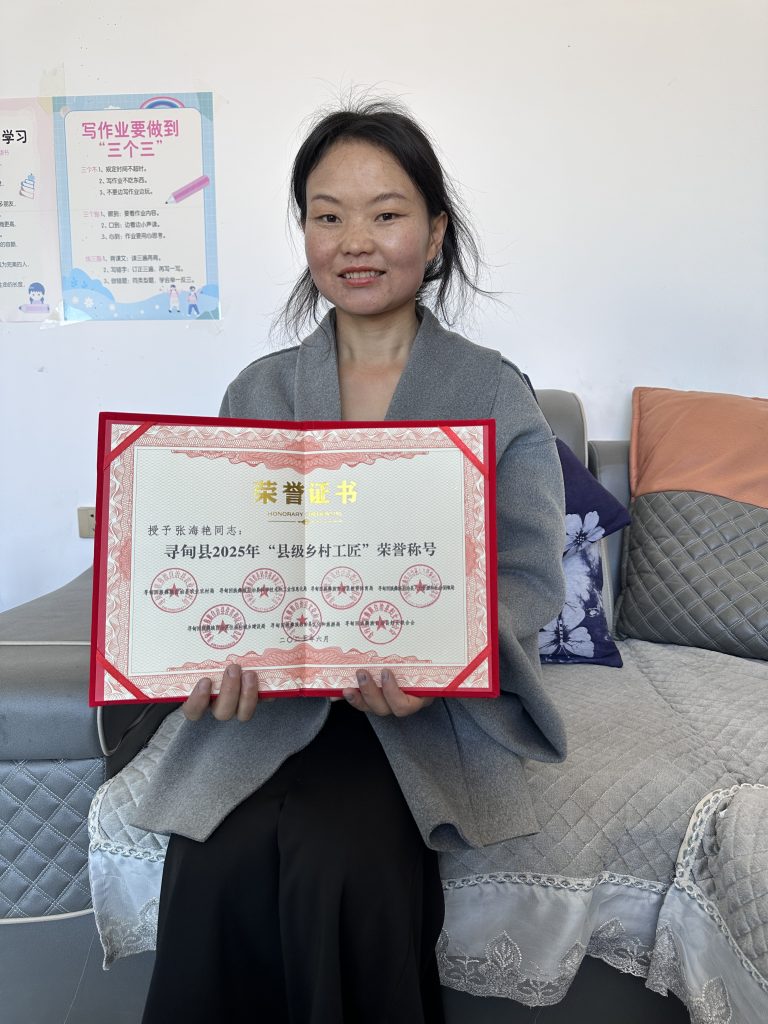
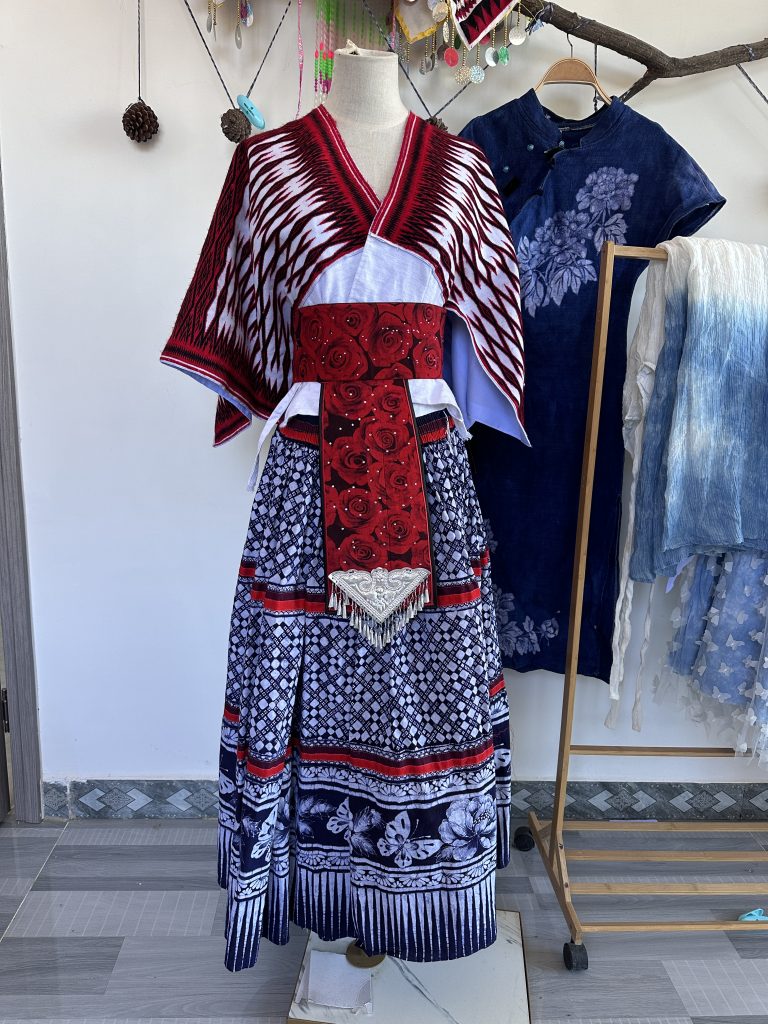
On 12 February 2026, facilitated by Long Haiyan, the project team visited the studio of Zhang Haiyan (张海燕), a county‑level bearer of Miao batik techniques. Zhang Haiyan (b.1990) is a folk artist who adheres to traditional handmade batik methods while embracing innovation. Her works are highly creative and practical in pattern, color, form, and product variety. For example, she has introduced intricate rose patterns alongside traditional Miao floral and cross motifs, and has experimented with red and black dyes in addition to the traditional indigo blue. However, she insists on using traditional beeswax rather than industrial wax. As she explained, “Industrial wax affects the dyeing result because it melts and falls off too easily; traditional beeswax, though scarce and more expensive, is the only way I can achieve the fine details I want.” In June 2025, Zhang Haiyan was awarded the honorary title of “County-Level Rural Artisan” of Xundian County. She takes great pride in her responsibility to demonstrate and pass on the art of batik to the public and to the younger generation. At the end of the interview, she expressed her gratitude to the ECura team and her hope to participate in international cultural exchange activities in the future.
(Photo by Tingting Tang, 12 February 2026)
(Photo by Tingting Tang, 12 February 2026)
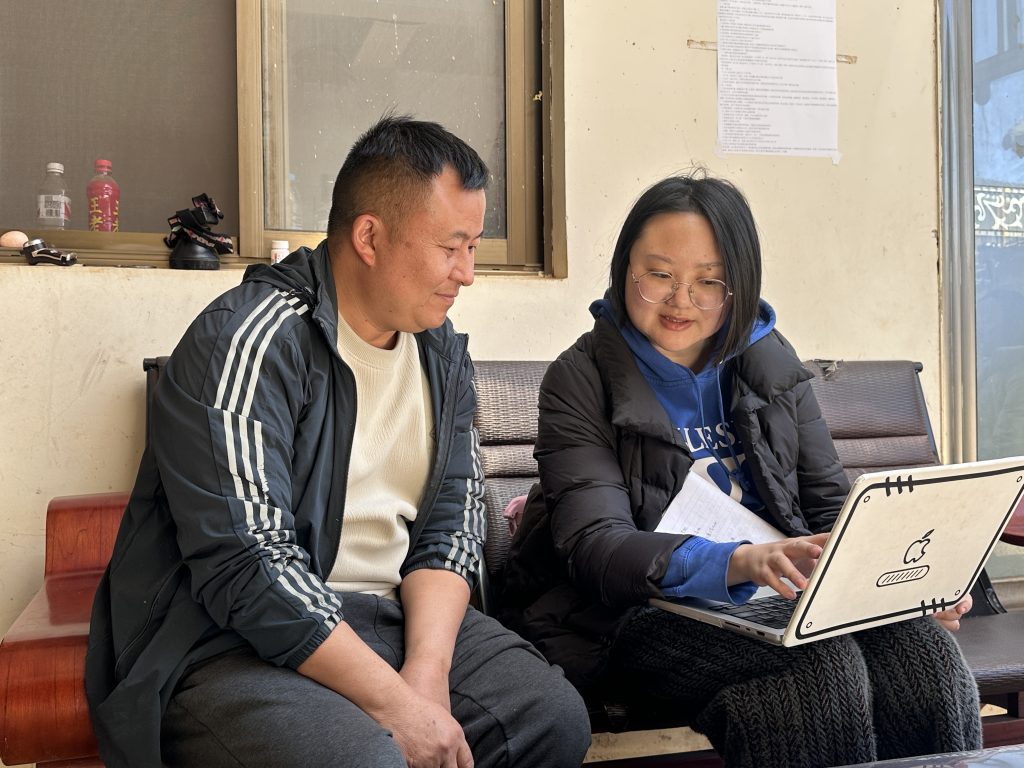
On 12–13 February 2026, Miao community collaborator and musician Zhang Hongming held informal discussions with the project team. He introduced the major cultural activities he had organized and participated in over the past year, including performances at the Huashan Festival (花山节), a traditional Miao festival celebrated locally and in surrounding villages. In addition, Yalun Yang, who has long supported Zhang Hongming in learning music notation software, provided in‑person guidance and collaborated with him on a line‑by‑line pronunciation check of the Miao lyrics in his original compositions. Zhang Hongming also explained his creative process and recorded demonstration vocals for several of his original works with the project team.
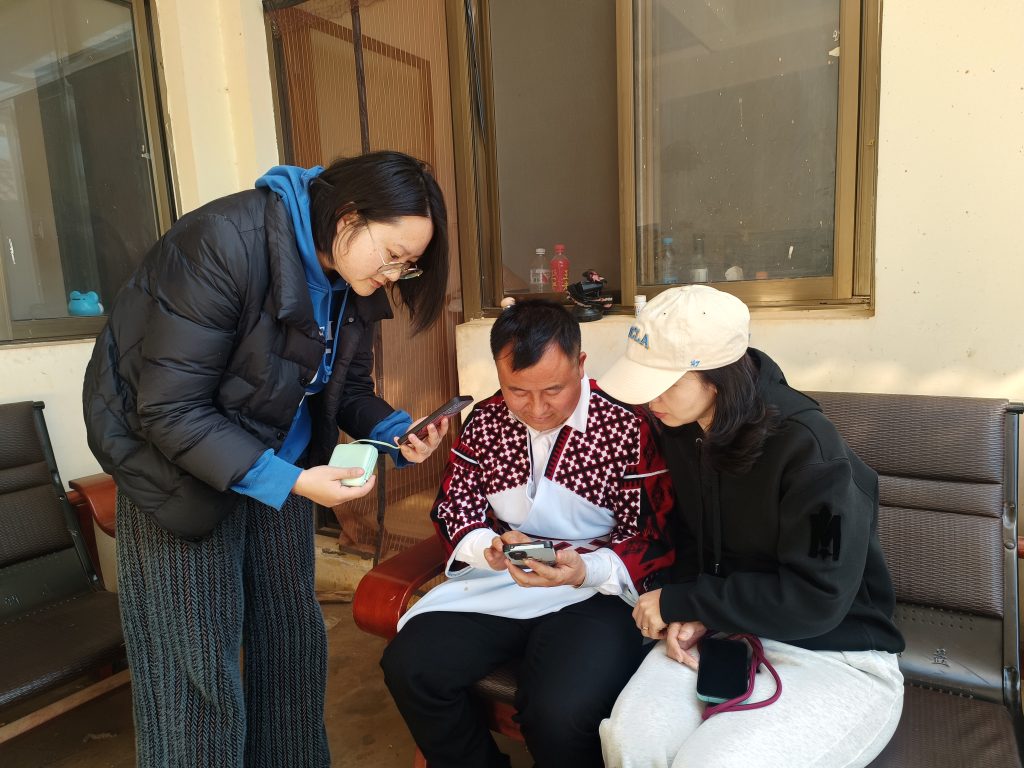
Text by Tingting Tang
ECura项目组与苗族社区合作者在小海新村会面
2026年2月6日,ECura项目组博士后研究员唐婷婷博士与科克大学民族音乐学博士研究生杨雅伦,在云南省昆明市与项目苗族社区合作者龙海燕举行了一次非正式座谈会。
会上,唐婷婷博士(于2025年9月正式加入项目)向龙海燕介绍了项目组主要成员及近期工作重点。龙海燕热情回顾了她与ECura项目、尤其是项目负责人钱丽娟博士的合作渊源。她向项目组表达了感谢,并希望在ECura项目支持下,有更多机会开展有利于本民族文化传承的活动。
随后,唐婷婷博士正式邀请龙海燕参与项目组前往小海新村的田野调查,协助进行为期三天的采访与小程序推广工作。龙海燕主动提出负责对接当地民间艺人与非遗传承人,行程与交通则由项目组安排。经过四天的协调,三人于2026年2月11日从昆明出发,抵达寻甸县小海新村,顺利开展了为期三天、收获丰硕的田野调查。
2026年2月11日,小海新村村长及苗族社区合作者、音乐家张洪明带领项目组参观了村委会、非遗保护展览室,并详细介绍了该村的搬迁历史、文化活动以及民间文化的传承现状。
2026年2月12日,在龙海燕引见下,项目组参观了当地苗族蜡染技艺县级非遗传承人张海燕的工作室。张海燕(生于1990年)是一位坚持传统纯手工蜡染技法、同时兼具创新精神的民间艺术家。她的作品在图案、色彩、造型及产品种类上均富有创造性与实用性。例如,她在传统苗族花卉与十字花纹样基础上大胆尝试精细的玫瑰图案;除传统蓝色外,也尝试了红色、黑色等色调。但她始终坚持使用传统蜂蜡而非工业蜡。张海燕解释:“工业蜡容易融化脱落,影响着色效果;传统蜂蜡虽然稀少且价格更高,但只有它才能达到我对图案细节的要求。”2025年6月,张海燕被评为寻甸县2025年“县级乡村工匠”荣誉称号,承担起向公众和下一代展示与传承蜡染技艺的责任,对此她感到非常自豪。访谈最后,她再次感谢ECura项目组的到访,并表示希望未来有机会参与国际文化交流活动。
2026年2月12日至13日,苗族社区合作者、音乐家张洪明与项目组进行了非正式座谈,介绍了过去一年他组织参与的主要文化活动及音乐创作作品,包括组织村民参加本地及周边村落的苗族传统节日“花山节”的表演。此外,长期支持张洪明学习打谱软件的杨雅伦在此次会面中对张洪明进行了面对面指导,并合作对其原创音乐作品中的苗语歌词进行了逐字发音校对。张洪明还现场介绍了他的创作理念与过程,并与项目组合作录制了几首原创作品的演唱示范。
文:唐婷婷 2026年4月2日
ECura Project Team Promotes the ECurator Mobile Mini‑Program in Miao Communities
From 11 to 13 February 2026, the ECura project team, together with Miao community collaborator Ms. Long Haiyan, conducted a three‑day visit to Xiaohai Xin Village in Xundian County, Kunming, Yunnan Province.
The fieldwork had three main objectives: first, to follow up on the progress of community‑led ethnic music and cultural activities in Xiaohai Xin Village; second, to meet with project collaborator and Miao musician Zhang Hongming, supporting him in learning music composition software and helping to transcribe his original compositions into staff notation and numbered musical notation; and third, to promote the project team’s newly launched mobile application, ECurator, within the local Miao community.
The ECurator app is now available for download on the App Store, Google Play, and as a WeChat mini‑program.
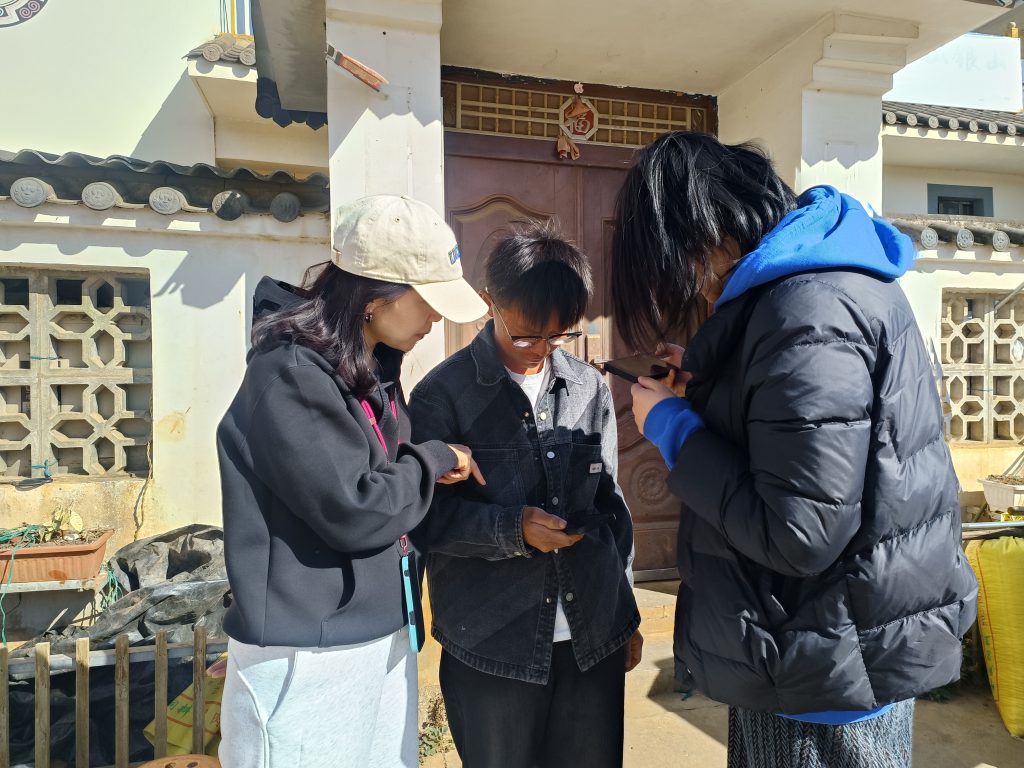
(Photo: Long Haiyan, 12 February 2026)
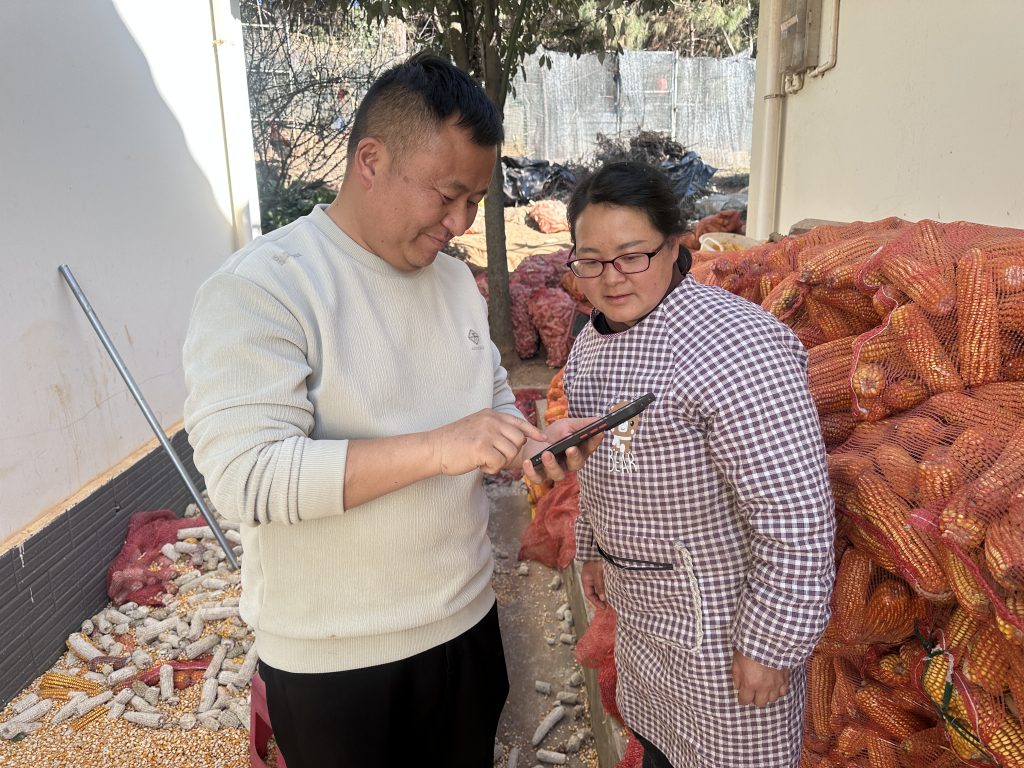
(Photo: Tingting Tang, 12 February 2026)
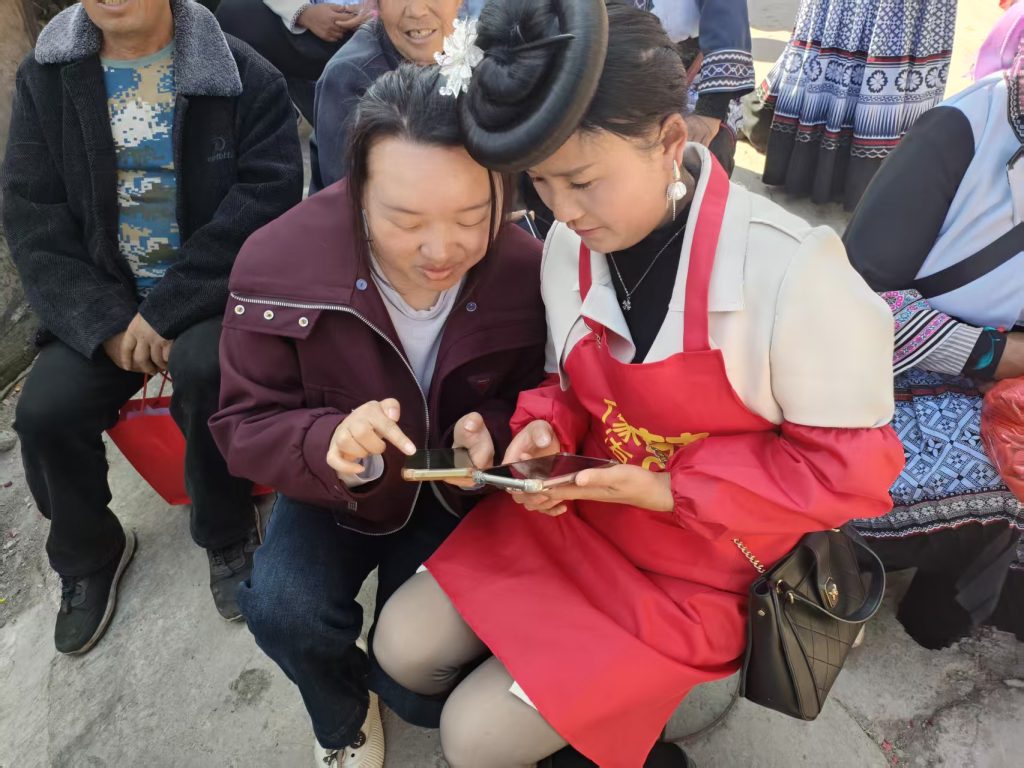
The project team—comprising Ms. Long Haiyan (Miao community collaborator), Yalun Yang (PhD student in Ethnomusicology at University College Cork), and Dr. Tingting Tang (Postdoctoral Researcher)—introduced ECurator and its Miao language corpus to the villagers in both Mandarin and the Miao language. They guided interested villagers through the process of downloading and using the app (Figure 1). After trying the app, Miao musician Zhang Hongming eagerly recommended it to his wife and taught her how to use it (Figure 2). During the experience, Zhang Haiyan (b. 1990)—a guardian of Miao batik intangible cultural heritage—listened to the traditional music of her people and said with deep emotion: “This is what the real ancient song sounds like” (see Video 1).
Beyond Xiaohai Xin Village, Ms. Long Haiyan also promoted the app in other Miao communities and collected user feedback (Figures 3 and 4). Overall, most local users showed strong interest in both the mobile app and the WeChat mini‑program and were eager to give them a try.
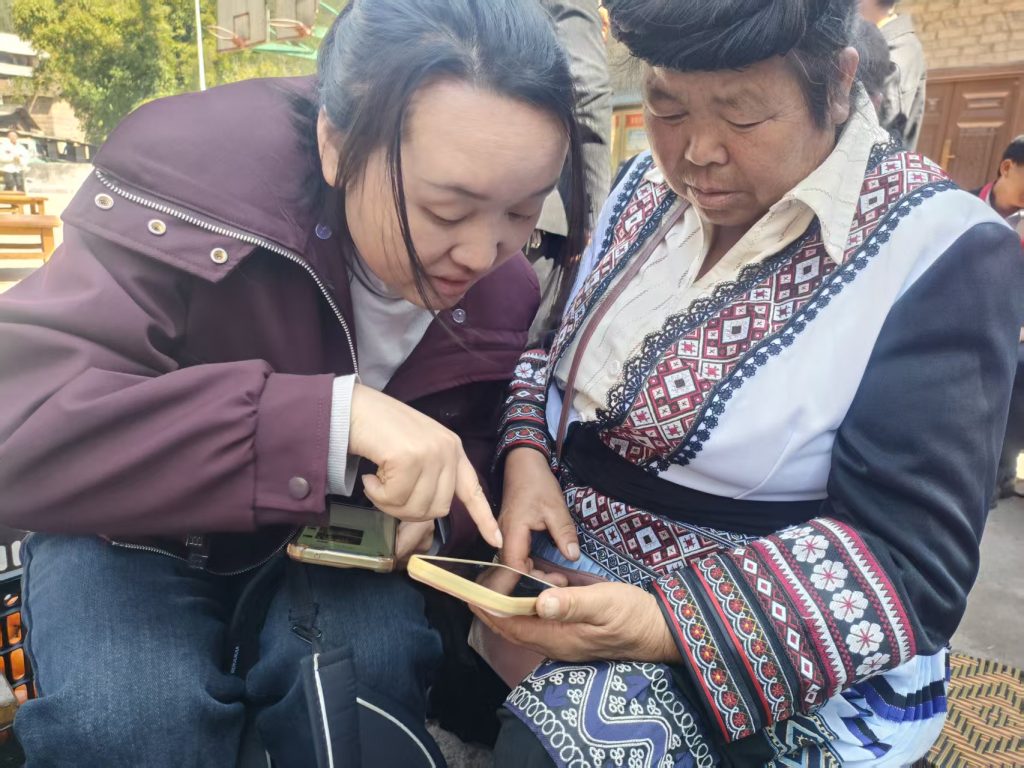
Text by Tingting Tang | 27 April 2026
ECura项目组在苗族社区推广ECurator移动小程序
2026年2月11日至13日,ECura项目组与苗族社区合作者龙海燕女士一同前往云南省昆明市寻甸县小海新村,开展了为期三天的深度探访。
本次田野调查的主要目的有三:一是跟进小海新村村民自主开展民族音乐文化活动的进展;二是访问项目合作者、苗族音乐家张洪明,支持他学习使用音乐软件进行创作,并帮助将其原创音乐作品的手稿转化为五线谱与简谱;三是在当地苗族社区中推广项目团队刚刚推出的移动应用程序“ECurator”。
目前,ECura项目研发的移动应用程序已可直接在App Store, Google Play和微信小程序中下载使用。
项目组一行三人——苗族项目合作者龙海燕女士、科克大学民族音乐学博士研究生杨雅伦,以及项目博士后研究员唐婷婷博士——分别用普通话和苗语向小海新村的村民介绍了ECurator及其中的苗族语料库数据资源,并逐一指导愿意体验的苗族村民下载和使用该应用程序(图一)。苗族音乐家张洪明在体验后,迫不及待地将应用推荐给自己的妻子,并教她如何使用(图二)。苗族蜡染非遗传承人张海燕(生于1990年)在体验时听到本民族的传统音乐时感慨地说:“这就是真正的古歌了”(见视频一)。 除了小海新村,龙海燕女士还在其他苗族村落进行了推广,并收集了苗族用户的使用反馈(图三、图四)。总体而言,大多数当地用户对手机应用和微信小程序表现出浓厚兴趣,并乐于尝试使用。
图一:张杰(张杰,生于2008年),来自小海新村的一位年轻参与者,评价道:“这非常新颖和有创意。我希望将来有机会学习苗语和苗族音乐。”(摄影:龙海燕,2026年2月12日)
图二: 张洪明教妻子张志美使用ECurator微信小程序。(拍摄:唐婷婷,2026年2月12日)
图三:张珍新(张珍新,生于1968年),来自小水井村的一位社区长者,分享道:“手机小程序让传统知识的传播变得非常方便。”(图片由龙海燕提供,2026年2月22日)
图四:王梦琪(王梦琪,生于2000年),来自小水井村的一位年轻学习者,评价道:“手机应用程序和小程序让像我这样的年轻人可以随时随地学习,非常方便。”(图片由龙海燕提供,2026年2月22日)
视频一:科克大学民族音乐学博士研究生杨雅伦向苗族蜡染技艺非遗传承人张海燕介绍如何使用ECurator手机应用程序。(视频拍摄:唐婷婷,2026年2月12日)
文:唐婷婷 2026年4月27日
Turning Life into Songs, Singing the Heart of a Mountain Village
Firewood crackles in the pit, lighting up the faces of the villagers gathered around it. With a microphone and a clear voice, Zhang Hongming begins his “campfire concert” once again. There is no professional sound system, no elaborate stage—yet every line of his songs touches the hearts of the villagers. By day, he is a teacher at a mountain early learning center, teaching children “do re mi.” By night, he becomes a singer who uses music to “keep a diary” of the village and to “find kindred spirits” for people’s hearts.
Music as a Bridge Between Hearts
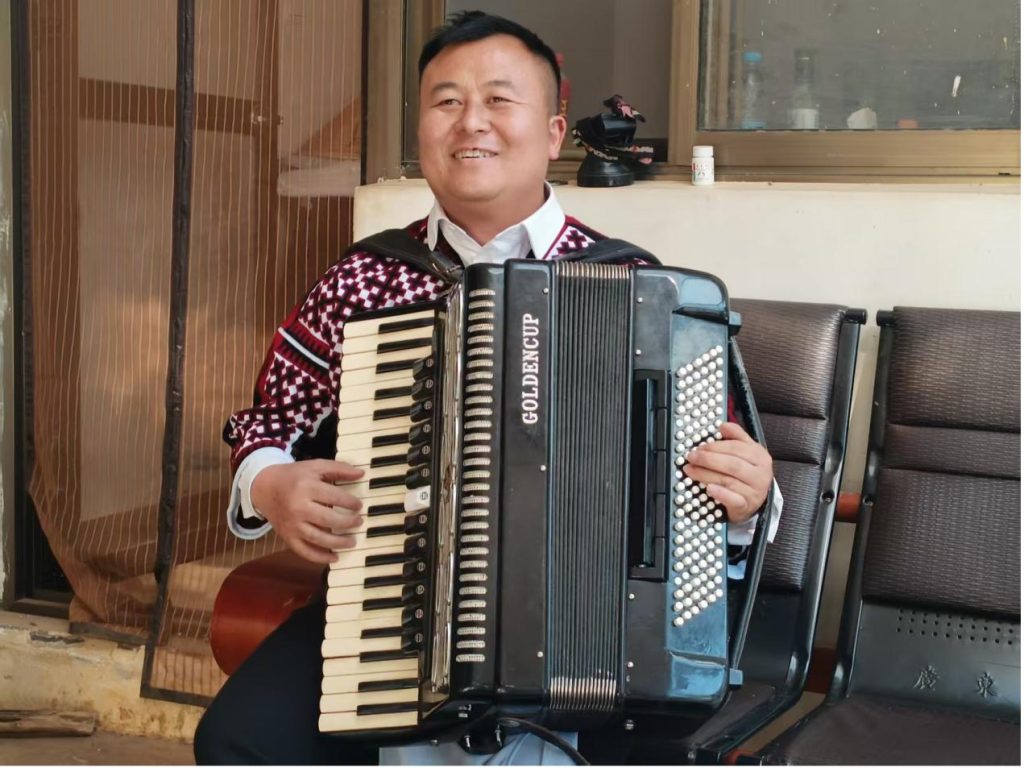
Zhang Hongming works primarily at an early learning center a few kilometers away. A few years ago, when he first entered the classroom, he encountered a group of shy Miao children who could hardly speak Chinese. Traditional teaching methods proved ineffective. Music offered a solution.
He began setting simple Chinese words and daily expressions to familiar Miao children’s tunes:
“Little hands clap, clap, clap; little feet stomp, stomp, stomp.”
“Good morning, the sun smiles; hello children, good morning to you…”
When familiar melodies carried unfamiliar language, the confusion in the children’s eyes gradually faded. They clapped and stomped to the rhythm, and before long, the Chinese words—like seeds—took root in their hearts through music.
“Music has no barriers. It is a bridge straight to the heart,” Zhang Hongming says. Through singing, the children not only learn language, but also experience joy, develop a sense of order, and feel the warmth of collective participation. He carefully selects songs, combining Chinese children’s songs with adapted Miao melodies, helping these mountain children connect with the wider world while remaining rooted in their own culture. When they sing both “Where Is Spring?” and traditional Miao songs in their young voices, Zhang Hongming feels a deep sense of fulfillment—he knows he is planting seeds of openness and confidence.
Songwriting as Everyday Storytelling
Zhang Hongming draws his songwriting inspiration from the land and the people around him. His material comes directly from daily life in Xiaohai Village: Mr. Wang’s pigs sold at a good price; Mrs. Li’s daughter was admitted to a county middle school; the melons had a good harvest; new streetlights brightened the village square. These seemingly small moments become the “big events” in his songs.
His lyrics are simple and grounded, often carrying the texture of everyday life. The melodies draw on traditional Miao tunes, blended with accessible pop elements. He records his songs on his phone and shares them through the village WeChat group and short-video platforms. To his surprise, these “local-style” songs quickly gained popularity.
“Hongming is singing about my family!”
“This tune is so catchy—even my mother can hum it!”
For him, this recognition is the greatest reward. One of his songs, “Drink! Drink!” (in Miao), has even become a must-play favorite at village banquets. These songs resonate because they capture the most genuine emotions and everyday joys of ordinary people. Written by the villagers, for the villagers, and embraced by the villagers, they become a shared cultural treasure. Through his voice, Zhang Hongming has found a powerful way to express the spirit of his community.
Cultural Activities as Social Glue
Outside his teaching work, Zhang Hongming is a central cultural figure in Xiaohai Village. More than a songwriter, he is an enthusiastic organizer and facilitator. Noticing the limited cultural activities in the village, he began encouraging residents to turn everyday life into songs and dances. He composes the music, designs the movements, and finds accompaniment using his phone.
At first, many villagers were hesitant. But with encouragement—and the participation of a few enthusiastic individuals—more and more people joined in, contributing ideas and helping create props. Rehearsals were often filled with laughter as well as occasional mishaps.
“In the past, after dinner we just watched TV or scrolled on our phones. Now we gather to dance, talk, and laugh. We feel much closer,” says Mr. Wang, one of the participants.

When their simple yet heartfelt performance was presented at the Huashan Festival and received enthusiastic applause, the participants experienced a strong sense of achievement and collective pride. The singing competitions and improvised folk song duels that Zhang Hongming organizes are equally lively. In these moments, music becomes more than entertainment—it becomes a form of social glue, strengthening relationships, reinforcing a sense of belonging, and bringing new vitality to village life.
Zhang Hongming says he has never aspired to fame. His dream is simple:
“I hope that whether young or old, whether working in the fields or far from home, when people hear my songs, they will smile and feel, ‘This is my life. This is how I feel.’ Music? It’s simply a way to sing what is in people’s hearts—beautifully.”
Text and photo by Long Haiyan (龙海燕), edited by Tingting Tang | 6 May 2026
把生活谱成曲,唱出乡里的心声
火塘里柴火噼啪,映照着围坐村民的脸庞。一个话筒,一副清亮的嗓子,张洪明又开始了他的“火塘音乐会”。没有专业的音响,没有华丽的舞台,但每一句歌词,都唱进了乡亲们的心坎里。这位白天在山区早教点教孩子们“do re mi”的老师,夜晚则是用音乐为村庄“写日记”、为心灵“觅知音”的行吟歌者。
音乐,是跨越隔阂的“启蒙密钥”与“情感纽带”
张洪明的“主战场”在几公里外的山村早教点。几年前,当他第一次走进教室,面对的是一群几乎不会说一句汉语、眼神怯生生的苗族娃娃。传统的教学方式在这里遇到了壁垒。是音乐,给了他灵感。他将最简单的汉语词汇和日常用语,编进苗族儿童耳熟能详的童谣曲调里。“小手拍拍,拍拍拍;小脚踩踩,踩踩踩” “早上好,太阳笑;小朋友,你们早”……当熟悉的旋律搭载着陌生的语言响起,孩子们眼中的迷茫褪去了,他们跟着节奏拍手、跺脚,不知不觉中,那些汉语词汇如同种子,伴着音乐的雨露,落入心田,生根发芽。
“音乐没有门槛,它是直通心灵的桥。”张洪明说。通过唱歌,孩子们不仅学会了语言,更在集体歌唱中获得了快乐、建立了规则、感受到了集体的温暖。他精心挑选的歌曲,既有汉语儿歌,也有他整理的苗族歌谣。他想让这些山里的孩子,在连接外部世界的同时,不断打开连接自己民族文化的“情感纽带”。当孩子们用稚嫩的童声,既唱《春天在哪里》,也唱《苗族儿歌》时,张洪明感到无比欣慰——他播种的,是包容与自信的种子。
创作,是普通人的“生活史诗”与“心灵共鸣”
张洪明的创作灵感,全部来源于脚下这片土地和身边这群可爱的人。他的音乐素材库,就是小海新村的日常。王大叔家养的生态猪出栏卖了好价钱,李婶家女儿考上了县里的中学,村里的香瓜喜获丰收,广场上新装了明亮的路灯……这些看似琐碎的喜悦与变化,都是他歌里的“大事记”。
他的歌词朴实无华,甚至带着泥土的芬芳,旋律也往往在传统苗歌的基础上,融入朗朗上口的流行元素。他在手机软件上简单录制,分享到村民微信群和短视频平台。没想到,这些“土味”歌曲迅速走红。“洪明唱的就是我家的事!” “这调子好听,我阿妈都会哼了!”村民的认可,是对他最高的奖赏。他的《喝酒!喝酒!》(苗语)甚至成了附近苗寨宴席上必点的“神曲”。这些歌曲之所以动人,正因为它道出了普通人最真实的情感和最细微的幸福。它们是为村民而写、由村民检验、最终归于村民的精神财富。张洪明用他的歌声,为这个沉默的村庄和沉默的群体,找到了响亮而深情的集体抒情方式。
组织,是激活社群的“黏合剂”与“欢乐引擎”
工作之余的张洪明,是小海新村最受欢迎的文化“酵母”。他不仅是创作者,更是热情的组织者和培训者。他看出村里文娱活动形式的单一,便主动提议,将日常生活所见编辑成曲、排练成舞。他自己作曲,设计舞蹈动作,用手机找配乐。一开始,村民们害羞、推脱,但在他和几位骨干的带动下,越来越多的村民加入进来,出主意、做道具。排练的过程笑料百出,却也其乐融融。
“以前吃完饭就是看电视、刷手机,现在大家聚在一起‘排舞’,说说笑笑,关系比以前更亲了。”参与演出的村民张大哥感慨。当这台粗糙却充满真诚的舞蹈在“花山节”上演,赢得满堂彩时,所有参与者的脸上都洋溢着前所未有的成就感和集体荣誉感。张洪明组织的歌咏比赛、即兴对歌会,同样人气火爆。音乐与文化活动在这里,超越了单纯的娱乐,成为强化邻里纽带、增进社区认同、激发内生活力的强大“社会黏合剂”。它让村庄在共同的旋律、共同的故事演绎中,心跳同频,情感共振。
张洪明说,他没想过成名成家,他的梦想很简单:“就是希望无论老人还是孩子,无论在地里干活还是在外面打工,听到我写的歌,能会心一笑,觉得‘这就是我的生活,我的心情’。音乐嘛,就是替大家把心里的话,美美地唱出来。”
图/文 龙海燕 2026年5月6日
Dancing into Unity: Women as Pillars of the Village
As evening falls, the cultural square of Xiaohai New Village (小海新村) in Xundian County (寻甸县) gradually comes to life. In the glow of the setting sun, groups of women gather, chatting and laughing. Standing at the center, calling out to everyone, is Su Xiulan (苏秀兰). She does not play the lusheng, a traditional Miao reed pipe instrument. Instead, she claps her hands and says warmly, “Sisters, let’s get moving!”
This is an ordinary scene in Xiaohai New Village (小海新村). It is also, almost every day, a “refueling station” for the Xiaohai Shuangfei Women’s Cultural Group (小海双飞妇女文艺队) after a long day’s work. For Su Xiulan (苏秀兰) and the members of this group, the place has long outgrown its role as a rehearsal space. It is a “corner for sorting things out,” where they share their worries and ease their troubles—and, above all, their shared spiritual home. And Su Xiulan (苏秀兰) is the true backbone who holds them all together.
From Quiet to Active: Hearts Reunited in the Square
In 2016, the villagers of Xiaohai New Village (小海新村) moved from their old mountain village into a newly planned resettlement site. The houses were beautiful and the roads were wide. But after the first flush of excitement faded, an indescribable quiet settled in among the neighbors. “We lived door to door, but it seemed we had nothing to say to each other. The sisters were busy with the house and then busy in the fields. Their faces showed tiredness, and there were fewer smiles,” one team member recalled.
Su Xiulan (苏秀兰) felt that distance more deeply than anyone. She has a warm heart, and she also holds a deep love for the songs and dances passed down from her ancestors. An idea took shape: she had to bring the sisters together again, and use the music and steps the Miao people love most to lift their spirits and restore their bonds.
The beginning was hard. At first, only two or three old friends responded, moving through steps that felt a little unfamiliar on the empty square. Su Xiulan (苏秀兰) was patient and unhurried. She started with the most familiar tunes and the simplest moves. Her warmth and patience, like a spring breeze, slowly opened everyone’s hearts. Gradually, more people came.
More importantly, this was not just a place to learn dance. When someone hit a rough patch or felt weighed down, during a break in the dancing or a moment of rest, she was willing to talk it over with Su Xiulan (苏秀兰). She listened patiently, spoke gently, and helped think things through. Many small family frictions and neighborhood spats quietly dissolved in that talking, laughing, and mutual comfort. “With Su Xiulan (苏秀兰) around, we feel at ease. She is our backbone.” That is what many members of the group truly feel. The lights and music of the square, like a warm and powerful magnet, draw the women out of their busy, scattered routines and bring them back together into a close-knit, mutually supportive community.
From Learning to Creating: New Steps Taking Shape
With their hearts united, their spirits rose. Su Xiulan (苏秀兰) was not content to only dance the old steps and learn the old routines. She led the group in establishing the Xiaohai Shuangfei Women’s Cultural Group (小海双飞妇女文艺队)—a name that carries their hopes for a bright future. She began guiding the members in a new effort: passing down the old tunes while also singing and dancing out their new life.

They wove the joy of moving into their new homes, their gratitude for good policies, and their hopes for a better life into their lyrics and steps. The rhythm of the traditional lusheng dance was blended with more energetic modern beats. The ancient tunes of the feige songs were given new lyrics celebrating the happiness of the present day.
This process quietly changed everyone. “Before, I didn’t dare speak loudly in front of strangers. Now, following Su Xiulan (苏秀兰), I can perform on stage!” The transformation of Ms. Wang (王大姐), a team member, is telling. With Su Xiulan’s (苏秀兰) encouragement and leadership, more and more sisters moved from shyness to confidence, from caring only about their own families to being willing to offer ideas for the larger community. The confidence built through song and dance spilled over into every part of life. They became more active in attending skills training and more willing to take part in the village’s public affairs. Song and dance became a window through which they opened themselves up and connected to a wider world, and it also enabled them to play a more important role in their families and community.

From Passing Down to Nurturing: Planting Roots for the Future
Su Xiulan (苏秀兰) has always kept one concern close to her heart: the good things passed down from our ancestors must not be lost in our generation. She saw that young people listened only to the latest pop songs on their phones, and fewer and fewer could sing the ancient songs in full. It worried her.
“Our songs hold the paths our ancestors walked, the principles of being a good person, and the wisdom of life. They are the ‘roots’ of the Miao people. They must not be lost.” With this belief, she turned the group’s activities into an open “classroom for traditional culture.” She not only organized the women to dance, but also used spare moments after meals to patiently and repeatedly explain the stories and meanings behind some of the old songs.
Now, as night falls each day, two kinds of moving melody blend in the square of Xiaohai New Village (小海新村). One is the lively, energetic new dance music of the members, full of the spirit of the times. The other is the ancient, heartfelt Miao songs they practice with care. Su Xiulan (苏秀兰) stands among her sisters, watching their confident, radiant smiles and the children nearby curiously imitating their moves. Her heart is filled with relief and hope. She understands that what she is doing goes far beyond leading people in dance and song. She is building a spiritual home for the women of this village, guarding a cultural memory for future generations, and nurturing an inner, lasting strength for the tomorrow of Xiaohai New Village (小海新村). That strength comes from culture, springs from women, and nourishes the present and future of the entire village.
Text and photo by Long Haiyan (龙海燕), edited by Tingting Tang | 16 Sep 2026
舞出凝聚力 妇女顶梁柱
傍晚,寻甸县小海新村的文化广场渐渐热闹起来。夕阳的余晖里,三五成群的妇女们有说有笑地聚拢。站在中心招呼大家的,是苏秀兰。她没有吹奏芦笙,而是拍着手掌,亲切地喊着:“姐妹们,咱们动起来!”
这是小海新村寻常的一幕,也几乎是“小海双飞妇女文艺队”每日劳作后的加油站。对苏秀兰和这支队伍的成员而言,这里早已超越了排练场的功能,是诉说心事、化解烦忧的“议事角”,更是她们共同的精神家园。而苏秀兰,是当之无愧地将大家凝聚起来的“主心骨”。
从静到动:广场上重聚的心
2016年,小海新村村民从山上的老寨,搬进了规划一新的安置点。房子漂亮了,路也宽敞了,可起初那股热闹劲儿过后,一种说不清的寂静在邻里间弥漫。“门对门住着,好像也没啥话说。姐妹们忙完家里忙地里,脸上都带着累,笑容也少了。”一位队员回忆道。
这种疏离感,苏秀兰体会最深。她是个热心肠,更对祖辈传下来的歌舞有着深厚的感情。她萌生了一个念头:得把姐妹们再聚到一块儿,用苗家最喜欢的音乐和舞步,把心气儿提起来,把情分再续上。
万事开头难。起初,只有两三个老姐妹响应,在空旷的广场上,跟着略显生疏的步子。苏秀兰不急不躁,就从最耳熟能详的调子、最简单的动作教起。她的热情和耐心,像春风一样,慢慢吹开了大家的心门。人,渐渐多了起来。
更重要的是,这里不单是学舞的地方。谁家遇到难处了,心里憋闷了,在跳舞的间隙,在休息的片刻,都愿意找苏大姐念叨念叨。她耐心听着,轻声劝着,帮着出主意。许多家庭的小摩擦、邻里间的小疙瘩,就在这说说笑笑、互相宽慰中悄然化解。“有苏大姐在,心里就踏实,有主心骨。”这是文艺队很多姐妹的心里话。广场的灯光和乐声,像一块温暖有力的磁石,将妇女们从各自的忙碌与琐碎中吸引出来,重新凝结成一个亲密、互助的集体。
从学到创:舞步里踏出的新
人心齐了,精神头就足了。苏秀兰不满足于只跳老的、学旧的。她带领大家成立了“小海双飞妇女文艺队”,名字寄托着对美好未来的期盼。她开始带着姐妹们一起琢磨:老调子要传,新日子更要唱出来、跳出来。
她们把搬进新家的喜悦、对好政策的感激、对新生活的向往,都编进歌词,融入舞步。传统的芦笙舞韵律,结合了更富活力的现代节奏;古老的飞歌曲调,填上了歌唱当下幸福的新词。
这个过程,悄然改变着每一个人。“以前我见了生人都不敢大声说话,现在跟着苏大姐,能上台表演了!”队员王大姐的转变很有代表性。在苏秀兰的鼓励和带领下,越来越多的姐妹从腼腆变得大方,从只关心“小家”到乐于为“大家”出谋划策。这份在歌舞中建立起的自信,延伸到了生活的方方面面。她们更积极地参加各种技能培训,更主动地参与到村庄的公共事务中。歌舞,成了她们打开自我、连接更广阔世界的一扇窗,也让她们在家庭和社区中扮演着更重要的角色。
从传到育:为未来种下根
苏秀兰心里始终绷着一根弦:老祖宗留下的好东西,不能在我们这辈人手里断了。她看到年轻人手机里播放的都是新潮歌曲,能完整哼唱古歌的越来越少,心里着急。
“我们的歌里,有祖先走过的路,有做人的道理,有生活的智慧,是苗家的‘根’,丢不得。”抱着这样的信念,她把文艺队的活动,变成了一个开放的“传统文化传习课堂”。她不只组织妇女们跳舞,还利用茶余饭后的时间,耐心地、反复地为姐妹们讲解一些古老歌曲背后的故事和寓意。
如今,每当夜幕降临,小海新村的广场上便交织着两种动人的旋律:一种是姐妹们欢快有力、充满时代气息的新编舞曲,另一种则是她们认真练习、悠远深情的苗家歌谣。苏秀兰站在姐妹们中间,看着大家自信飞扬的笑容,看着孩子们在边上好奇模仿的身影,心里充满了欣慰与希望。她明白,自己所做的,远不只是带领大家跳舞唱歌,她是在为这个村庄的妇女们搭建一个精神家园,为子孙后代守护一份文化记忆,为小海新村的明天,培育着内生而持久的力量。这股力量,源自文化,发于妇女,滋养着整个村庄的现在与未来。
文 龙海燕 2026年9月16日