
The Hani are an ethnic minority primarily residing in the Southwestern region of China. As of 2020, the Hani population in China exceeded 1.7 million, making them one of the major ethnic minorities in Yunnan Province (云南省). They are mainly concentrated in areas such as Honghe Hani and Yi Autonomous Prefecture (红河哈尼族彝族自治州) , Pu’er (普洱市), and Xishuangbanna Dai Autonomous Prefecture (西双版纳傣族自治州) ,with smaller populations also found in Laos and Vietnam in Southeast Asia.1
哈尼族是一支主要生活在中国西南地区的少数民族。截至2020年,中国境内的哈尼族人口已超过170万,是云南省主要少数民族之一。他们主要分布在云南红河哈尼族彝族自治州、普洱市、西双版纳傣族自治州等地,也有一些分布在老挝和越南等东南亚国家。
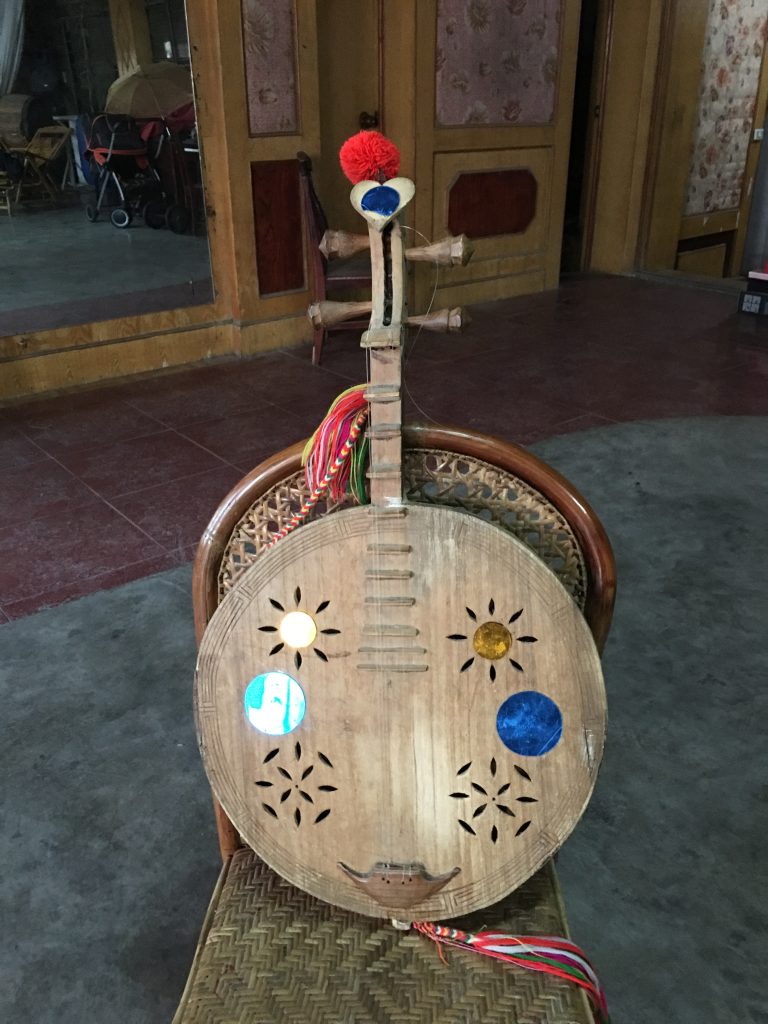
Hani Sixian 哈尼四弦
The Hani sixian (4 string lute) is a traditional plucked instrument of the Hani people, renowned for its bright and mellow tone as well as its versatile playing style. It features a wooden body and four strings, with a compact design that makes it easy to carry, making it suitable for both solo performances and accompaniment.
This photo shows a Hani sixian made by Zhiming Wu (吴志明) from Honghe County (红河县), part of the Honghe Hani and Yi Autonomous Prefecture (红河哈尼族彝族自治州). Devoted to preserving Hani musical traditions, Zhiming Wu set up a traditional music learning center in the area, offering vocational training for students. By the time this photo was taken in May 2018, the music center had over 20 students actively learning and helping to carry forward Hani cultural heritage.
哈尼四弦是哈尼族传统的弹拨乐器,以其清亮柔和的音色和灵活多样的演奏风格而闻名。哈尼四弦由木质琴身和四根弦组成,外形小巧,便于携带,适合在独奏或伴奏中使用。这张图片展示的哈尼四弦,是由红河哈尼彝自治州红河县的吴志明制作。吴致力于传承哈尼族的音乐文化,他在当地建立了具有中等专科文凭的传统音乐传习馆。在这张照片的拍摄之时(2018年5月),已有二十多名学生在此学习。
Hani Sanxian 哈尼三弦
The Hani sanxian (3 string lute) is a traditional plucked instrument of the Hani people. It consists of a wooden body and three strings, producing a deep and expressive sound suitable for both solo performances and accompaniment. The Hani sanxian is often used in folk dances, festivals, and wedding ceremonies, serving as an important tool for expressing emotions and telling stories of daily life. Its performances are typically improvisational, with melodies that can be either tender and lyrical or lively and cheerful, fully showcasing the diverse playing styles of Hani music.
The Hani sanxian shown in the picture were also made by Zhiming Wu (吴志明).
哈尼三弦是哈尼族传统的弹拨乐器。三弦由木质琴身和三根弦组成,音色深沉而富有表现力,适合独奏或伴奏。哈尼三弦常用于民间歌舞、节庆活动和婚礼仪式中,是表达情感和讲述生活故事的重要乐器。演奏内容通常具有即兴特点,旋律既可深情婉转,也能热情欢快,展现了哈尼族音乐表达风格的多样性。
图片中展示的三弦,也是由吴志明制作的。
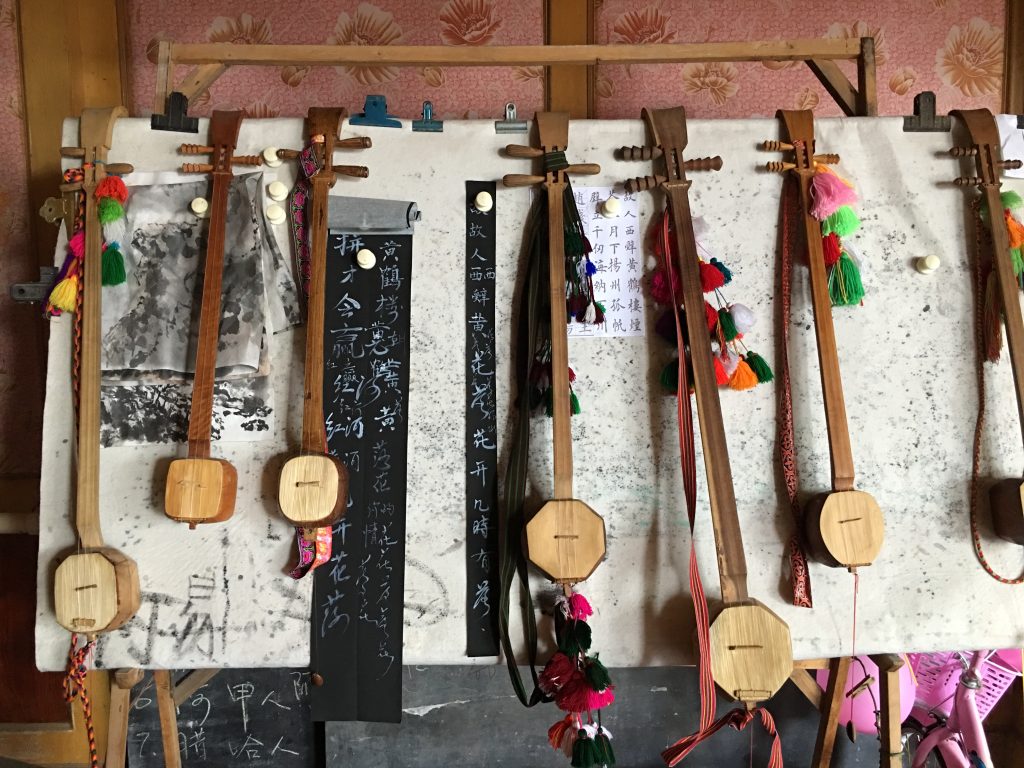
Hani sanxian (3 string lute) made by Zhiming Wu from Honghe County, Photo by Lijuan Qian in May 2018
Hani Songs 哈尼族歌曲
This video shows Xialing Chen (陈夏苓), a student at the traditional music learning center, performing a mountain song with sanxian accompaniment. Since childhood, Xialing Chen has been deeply influenced by her family and has developed a strong passion for Hani music. Her father, Xiniang Chen (陈习娘), is a nationally recognised inheritor of the intangible cultural heritage project representing Hani polyphonic folk songs.
这个视频是传习馆的学员陈夏苓表演的山歌弹唱。夏苓从小深受家庭熏陶,对哈尼族音乐有着浓厚的兴趣。她的父亲是国家级非遗项目哈尼族多声部民歌代表性传承人陈习娘。
Hani Love Songs 哈尼情歌
This video provides the scene of Hani women from Qidieshang Village (期垤上寨) in Honghe County (红河县), Honghe Prefecture (红河哈尼族彝族自治州), singing love songs in the mountains. In Hani tradition, love songs are not performed within the village but must be sung in the mountains outside the village.
这个视频展示了红河州红河县期垤上寨的哈尼族妇女在山间演唱情歌的场景。在哈尼族的传统文化中,情歌不能在村子里演唱,需要到村外的大山里去唱。
This video depicts local Hani youth performing songs on the Samaba (撒玛坝) terraceds fields in Honghe County (红河县), Honghe Prefecture (红河哈尼族彝族自治州).
这个视频呈现了当地的哈尼族青年在红河州红河县的撒玛坝梯田上唱歌的场景。
Hani Wedding Songs 哈尼婚嫁歌
In the past, people in many parts of China sang wedding songs when their daughters got married, a tradition that still exists in some ethnic minority areas, such as among the Hani, Yi, and Naxi in Southwest China. Since daughters typically married outside their village, and poor road conditions in the past made travel difficult, married daughters rarely had the opportunity to return to visit their parents. Furthermore, life at their mother-in-law’s house was often hard. As a result, the tunes of wedding songs were often very sorrowful. In this video, Jiashou Lu (卢加收), a Hani singer from Pinghe Town (平河镇), Lüchun County (绿春县), Honghe Prefecture (红河哈尼族彝族自治州), Yunnan Province (云南省), is performing a wedding song. She mentioned that she handmade the hat she is wearing.
过去,中国许多地方的人在女儿出嫁时会唱婚嫁歌,这种习俗在一些少数民族地区仍然存在,例如在中国西南地区的哈尼族、彝族或纳西族中。由于女儿通常是嫁到村外,而过去道路条件差,出行困难,已出嫁的女儿很少有机会回来看望父母, 在婆家的生活又多半艰辛。因此,婚嫁歌曲的曲调通常十分悲伤。视频中,来自云南省红河州绿春县平河镇的哈尼族歌手卢加收正在演唱婚嫁歌。她提到,头上戴的帽子是自己亲手制作的。
Hani Tree Ancestor Worship 祭茶祖仪式
This video shows a tree ancestor worship held in the local primeval forest by Hani shaman Xuecai Zhang (张学才), his wife Pingying Lu (陆萍英), and another close relative. According to Xuecai Zhang, the ancestral tree in the video is more than 1,000 years old.
这是哈尼族萨满张学才和她的妻子陆萍英以及另外一位近亲属在当地的原始森林里举行祭茶祖仪式的视频。据张学才介绍,视频中的这棵茶树王已有1000多年的历史了。
- State Council Information Office of China. 2014. China’s Ethnic Minorities. 2nd ed. Beijing: Ethnic Publishing House. ↩︎