
Local Yi Children Sing Traditional Meige Songs in Yi and English
The ECura team members have been working closely with the Yi villagers from Mayou, teaching the local Yi children how to sing the English versions of traditional Meige Children’s songs. After going through the processes of song selection, lyrics translation, musical notation, and online English teaching, the Yi children learned to sing the songs bilingually.
ECura团队与马游村的彝族村民们紧密合作,教会了当地彝族孩子们演唱梅葛童谣的英语版本。在经历选歌,翻译,制谱,线上英文教学等流程后,彝族孩子们学会了用双语演唱梅葛童谣。
Program 1: To Carve a Wooden Trough 挖木啦

Program 2: Hide and Seek 捉迷藏
Program 3: Little Bee You Work Hard 小蜜蜂你真辛苦

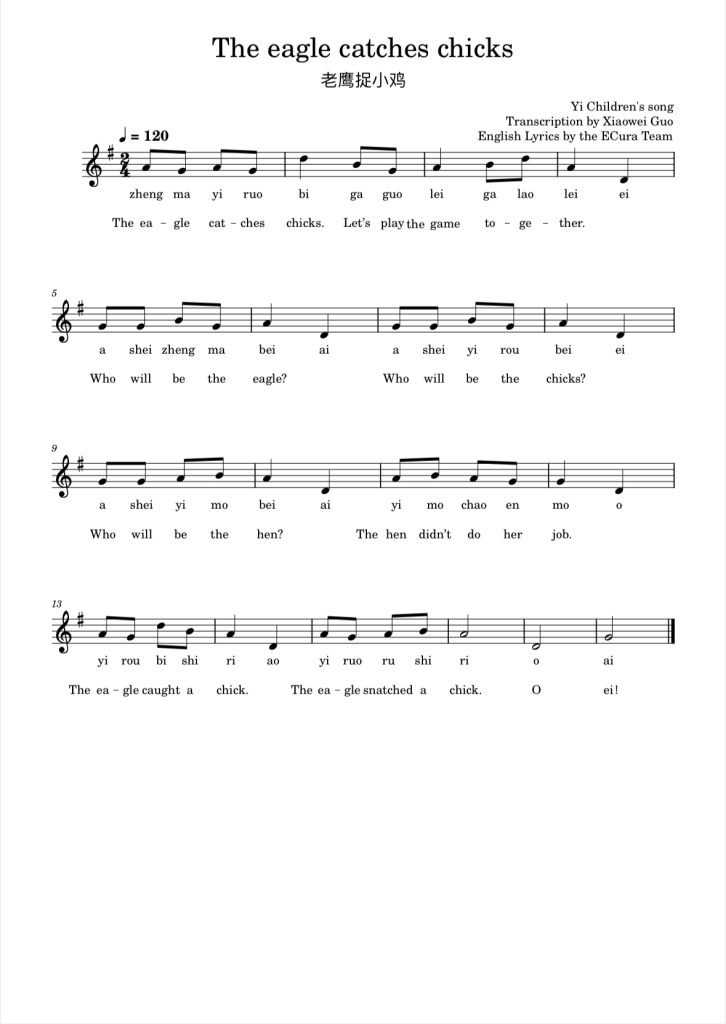
Program 4: The Eagle Catches Chicks 老鹰捉小鸡
Program 5: The Tune of Rain 下雨调

Program 6: Creating the Sky and the Earth: The Questions and Answer 开天辟地 问和答
The songs “Question” (问) and “Answer” (答) form part of a grand Yi ethnic epic that explores the origins of heaven and earth through the traditional tune of Ai ga le (哎嘎嘞). Performed in a common Yi vocal style that utilizes a call-and-response format, these songs offer a rich narrative depth and cultural insight. The following are some characteristics of this type of tune.
- Rhythm and Tempo
From the use of time signatures like 3/4, 6/4, 4/4, and 2/4, it is evident that both songs are characterized by their highly freeform rhythmic structure lacking strong rhythmic sensibility. This approach allows for a more fluid and expressive delivery, akin to natural speech patterns. When dealing with such free and loose rhythms, it can be challenging to decide how to standardize the rhythmic notation. In such cases, traditional time signatures may not accurately reflect the true fluidity and expressiveness of the music. For this type of music, more flexible notation methods may be needed to capture its unique rhythmic characteristics. Some contemporary Western composers choose not to use fixed time signatures, or they use irregular time signature changes to better depict the music’s free flow. Additionally, incorporating specific performance instructions into the score, such as libero (freely) or ad libitum (at one’s discretion), can also help. Given that this is a common feature in songs from minority groups in Southwest China, designing suitable rhythmic notation for these characteristics requires further exploration.
- Mode
The primary notes used in both songs, ‘dol, re, mi, fa, sol, la’, are reminiscent of the traditional Chinese pentatonic scale. I will analyse their melody and mode using the solfège names corresponding to the Chinese scale degrees: gong (宫), shang (商), jue (角), zhi (徵), yu (羽).
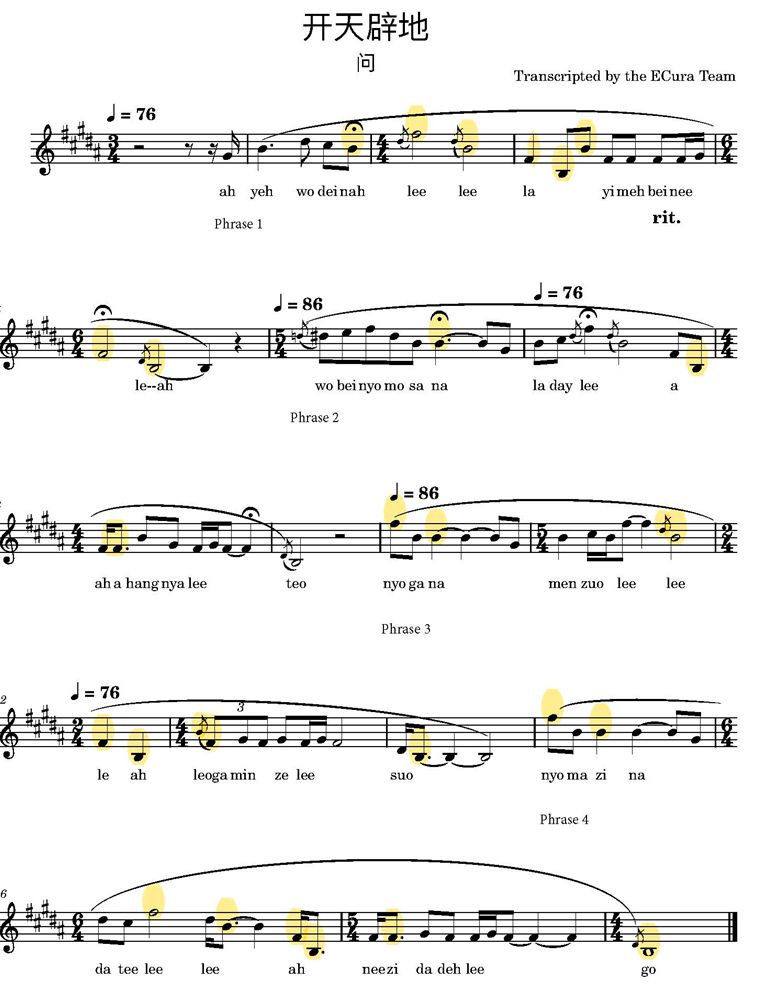
- “Question” is characterized by a loose rhythm yet can be distinctly segmented into four phrases, each concluding on the tonic dol (宫), indicating a Gong mode (宫调式).
- “Answer” consists of eleven phrases. Notably, although the transcribed sheet music is in C# and C modes, the performer appears to lower the pitch by a semitone after the ninth measure, likely due to the initial pitch being set too high. Despite this adjustment, all 11 phrases consistently resolve on dol (宫), reinforcing the piece’s adherence to the 宫调式 (Gong mode), similar to the “Question” section.
- Melodic Features
- Throughout both songs, there is a prevalent use of intervals common in Yi music, such as parallel fifths and fourths, observable in measures like 3, 5, 7, and 10 of “Wen”. Besides, each musical phrase ends with an ornamentation that quickly slides from a note a third higher than the tonic down to the tonic dol (宫).
- Both “Question” and “Answer” essentially have only one main melodic line or theme. The variation within each musical phrase arises from the individual improvisations by different singers, particularly in terms of rhythm and ornamentation. However, these improvisations are all based on the foundational or main notes of the melody. To illustrate this, I highlighted the main notes of the melody in yellow in the musical score of “Question”, making it easy to recognize that, despite individual variations by the singers, the core melody remains consistent throughout both songs.
- Conclusion
The song “Question” and “Answer” features a free and fluid rhythmic structure with melodies that unfold similarly to spoken language. They utilize improvisational techniques, with specific musical intervals like parallel fifths and fourths, and are rich in decorative notes, all of which highlight the unique characteristics of Yi ethnic music. In long narrative songs like these, it’s common for Yi and other minority groups in Southwest China to repeat melodies. This practice not only makes the music more narrative-driven but also helps to preserve a recognizable musical identity, ensuring that these familiar melodies remain a vital part of the community’s collective memory.
