
Bai People
Bai, also called Minjia, are a people of northwestern Yunnan province, southwest China. The Bai language – classified within the Yi group of Tibeto-Burman languages – is spoken today by more than 1 million people of the Bai nationality.1 Bai people are concentrated in and around communities such as Xiaguan, Dali, Yunlong, Eryuan, Jianchuan, and Heqing, all located within the borders of the Dali Bai Autonomous Prefecture in northwest Yunnan. Their principal city, Dali, was the capital of the kingdom of Nanzhao (737-902).2 The Bai people are known for their rice-growing culture, their craftsmanship, their singing and their high degree of Chinese acculturation.
白族,也被称为民家,主要居住在中国西南部云南省的西北地区。白语属汉藏语系藏缅语族彝语支, 目前有超过一百万的白族人使用。白族主要集中居住在云南省西北部的大理白族自治州内,如下关、大理、云龙、洱源、剑川和鹤庆等地。他们的主要居住城市大理,曾是南诏王国(737-902年)的首都。白族以稻米种植文化、工艺制作、歌唱以及高度的汉化程度而著称。
1 G. Thurgood and R.J. LaPolla (eds.). The Sino-Tibetan Languages, Routledge, 2003.
2 C. Backus, The Nan-chao Kingdom and T’ang China’s Southwestern Frontier, Cambridge University Press, 1982.

Qifeng
Qifeng village (起凤村), Eryuan County (洱源县), Dali Bai Autonomous Prefecture (大理白族自治州), Yunnan Province (云南省) has a population of 3,399, of whom are all Bai. The village sustains various small community groups that practice various Bai music traditions on a daily basis. The villagers remain highly active in cultural practices, including religious rituals in the village temple, which accommodates three different religions (Buddhism, Daoism, and Confucianism) and each religion has its own ritual music ensemble.
In Qifeng Village, most young people go out to work or study, resulting in a significant aging population in the village. Elders aged 65 to 80 have become the main guardians of the Bai traditional music culture. Despite the lack of professional cultural preservation organizations and experienced managers or leaders in the village, these elders, who are passionate about Bai music and dance, spontaneously protect and inherit this precious ethnic art. The villagers ‘make friends through music,’ exchanging tunes for leisure and companionship, thus establishing a harmonious and egalitarian musical cultural community. During traditional festivals and religious events, villagers gather enthusiastically, with women leading the singing and men generally providing instrumental accompaniment. On non-festival days, villagers also spontaneously organise at least one day trip each month to nearby scenic spots for musical practice. These music activities, organised and participated in by the villagers, not only showcase their love for Bai traditional music culture but also strengthen the community’s interconnectedness and mutual support.
起凤村(Qifeng Village)位于云南省大理白族自治州洱源县,全村有3,399人且全都是白族居民。该村维持着多个小型社团,他们每天都在实践着各式各样的白族音乐传统。村民们在文化实践方面保持着高度活跃性,包括在村庙进行的宗教仪式。这座庙宇容纳了佛教、道教、和儒教三种不同的宗教, 且每种宗教都有自己的礼乐合奏团。
在起凤村,大多数的年轻人都外出务工或求学,村里老龄化程度较深。起凤村65至80岁的老年人成为白族传统音乐文化的主要守护者。尽管在村内缺乏专业的文化保护组织和有经验的管理者或带头人,这些热爱白族音乐和舞蹈的老人们仍然自发地保护及传承宝贵的民族艺术。村民们 ‘以乐会友’,通过自娱自乐的方式与同伴们进行音乐交流,建立了一个和谐平等的音乐文化社区。每逢传统节日和宗教活动,音乐爱好者们热情相聚,女性们主导唱歌,男性一般自带乐器伴奏。在非节庆日时,村民们每月也会自发组织至少一次的一日游活动,前往附近风景优美之处进行音乐演练。村民们组织并参与的音乐活动不仅体现了他们对白族传统音乐文化的热爱,更加强了社群邻里之间的互联互助。
Bai Zu Diao
Bai Zu Diao (白族调; Bai tune) is a genre of traditional accompanied narrative singing of the Bai people of Dali Bai Autonomous Prefecture, northwestern Yunnan province, southwest China. It is presumed that the singers are singing in the Bai language. In 2020, the tradition of Eryuan Xishan Bai Zu Diao (洱源西山白族调), centering on Xishan Township (西山乡), Eryuan County (洱源县), was included in the Fifth Batch of the List of Representative Items of Intangible Cultural Heritage of Dali Prefecture (大理州第五批州级非物质文化遗产代表性项目名单).
The sole accompanying instrument used in Bai Zu Diao performance is a locally made Long Tou San Xian (龙头三弦, 3-stringed long-necked fretless plucked lute with skin-covered soundbox) with hexagonal soundbox and carved dragon head. The soundbox of the Lontou San Xian is traditionally covered on the top and bottom with multiple layers of tissue paper, although sheepskin is sometimes also used.
白族调是中国西南地区云南省西北部大理白族自治州白族人民的传统伴奏叙事歌唱形式。白族调由白语演唱。2020年,大理洱源县西山乡的白族调,被列入大理州第五批州级非物质文化遗产代表性项目名单。龙头三弦是白族调表演中唯一使用的伴奏乐器。龙头三弦有三根长弦,是呈长颈状的拨弦乐器。其声箱为六边形并雕有龙头装饰,声箱在顶部和底部覆盖多层棉纸,有时也使用羊皮覆盖。
Ba Wang Bian
Ba Wang Bian (霸王鞭 ; Rattle Stick Dance) is the most representative and most widely spread dancing form of the Bai people in Yunnan Province. It is performed not only in some traditional folkloric activities such as “Raosanling’, “Celebrating the First Lunar Month”, and “Farmers’s Celebration”, but also on other occasions such as house-buildings, weddings, or festivals. Ba Wang Bian has a long history and was recorded in detail in the poem “Raosanling Zhuzhici” of Duan Wei, a poet of County during the Qing Dynasty.
霸王鞭舞是云南省白族最具代表性且传播最广的舞蹈形式。它不仅在“绕三灵”、“闹春节正月”、“田家乐”等传统民俗活动中表演,而且在建房、嫁娶或喜庆佳节等场合中表演。霸王鞭舞有着悠久的历史。《大理县志稿》中清代诗人段位的诗《绕三灵竹枝词三首》中有关于霸王鞭舞的详细记载。
Bai musical instruments
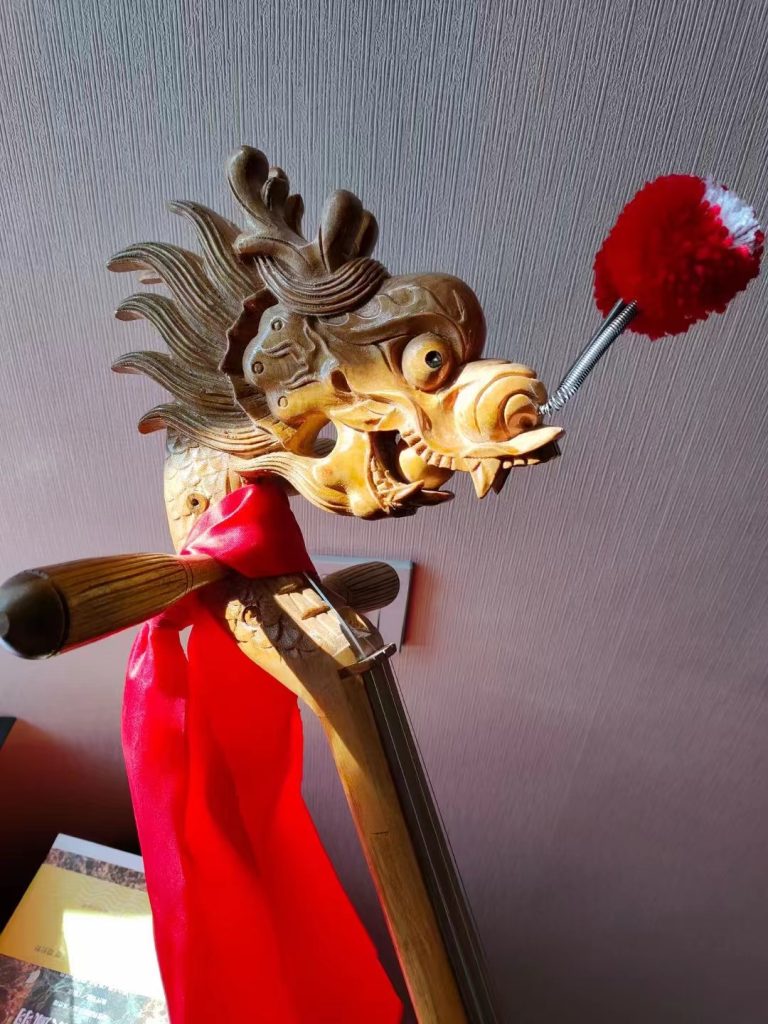
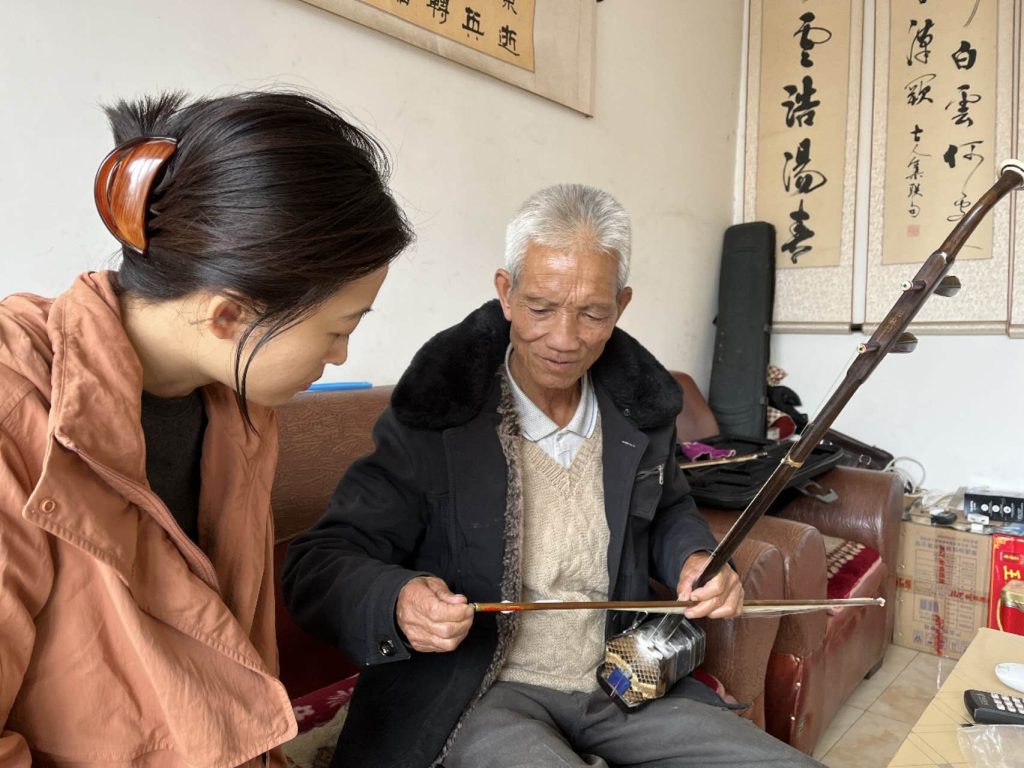
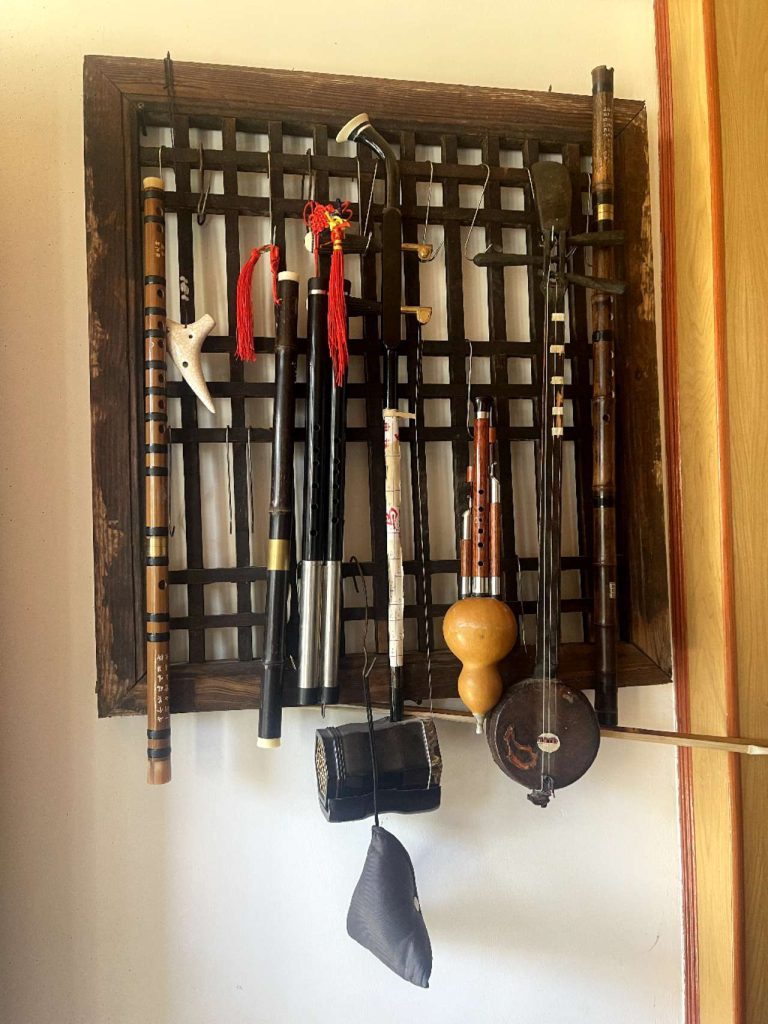
The Bai people has a wide variety of folk musical instruments with very rich expressiveness, among which the most widely circulated and representative folk instruments in the Bai region are the plucked string instrument San Xian (三弦) and the wind instrument Suo Na (唢呐).
There are three sizes of Bai San Xian: large, medium, and small. Its structure is not much different from the Han San Xian, but its timbre, playing methods, and techniques have their own unique style. The large San Xian has a richer timbre, mainly used to accompany the Bai folk art form “Daben Tune (大本曲),” with often played pieces including “Da Bai San Tai (大摆三台) ” and “Xiao Bai San Tai (小摆三台),” etc.; the medium San Xian (also known as dragon-head San Xian, 龙头三弦) has a peculiar shape, generally crafted by folk wood carving artisans from harder, high-quality wood. The dragon-head San Xian has a mellow and deep tone, strong penetration, larger volume, and is good at expressing people’s delicate inner thoughts and feelings. It is the main accompanying instrument for Bai folk songs and narrative singing, and also a solo instrument. More famous solo pieces include “Jianchuan Tune (剑川调),” “Fengyu Bai Tune (凤羽白族调),” “Dianbei Tiangeng Tune (甸北田埂调),” etc. The small San Xian is smaller in size, with a bright, exquisite, and soft tone, rich playing techniques, strong expressiveness, and often uses techniques such as vibrato, glissando, and tremolo. Representative pieces include “Didi Tune (滴滴调),” “Gengzi Tune (埂子调),” etc.
The Bai Suo Na has seven tone holes on the front and none on the back, often using the “borrowing tone” method of playing. The tone of the Bai Suo Na is bright, rugged, and strong, with a unique style. Its high notes are crisp, the low notes are rich, it has a wide range, and very expressive. There is a rich heritage of Bai Suo Na repertoire tunes passed down among the people, with hundreds of tunes to date. There are tunes that represent joy and celebration, as well as those that express ceremonies, sadness, and various other moods.
白族的民间乐器种类较多,表现力非常丰富,其中在白族地区流传最广、最有代表性的民间乐器是弹拨乐器三弦和吹管乐器唢呐。
白族三弦有大、中、小三种,它的结构与汉族的三弦区别不大,但其音质和演奏方法、演奏技巧却有着自己独特的风格。大三弦的音质较为浑厚,主要用于白族民间曲艺 “大本曲” 的伴奏,常演奏的乐曲有《大摆三台》、《小摆三台》等; 中三弦(也称龙头三弦)的形制奇特,一般由民间木雕工匠用较坚硬的上等木材精心制作而成。龙头三弦的音色圆润、深沉,穿透力强,音量较大,善于表达人们内心细腻的思想感情。它是白族民歌和说唱的主要伴奏乐器,同时又是独奏乐器。较著名的独奏曲有《剑川调》、《凤羽白族调》、《甸北田埂调》等。小三弦的体积较小,音色明亮而妙柔和,演奏技巧丰富,表现力强,演奏时多用揉弦、滑音、波音等技巧,代表曲目有《滴滴调》、《埂子调》等。
白族唢呐的正面有七个音孔, 而背面没孔,演奏时常采用 “借音” 的吹奏方法。白族唢呐的音色具有明亮、粗犷、强烈的独特风格,它的高音清脆,低音浑厚,音域较宽, 表现力很丰富。在民间流传的白族唢呐曲牌非常丰富,流传至今的唢呐曲牌有上百首。有表现欢乐、喜庆的, 也有表现祭祀、哀伤等各种情调的曲牌。