
Meige translation
In May 2022, Xiaowei Guo, a cultural bearer of the Meige culture of Yi people, published “The Abridged Version of the Yi Meige Epic,” totaling 520,000 characters. This work not only encapsulates the essence of three books—”The Origin of Meige,” “The Love Songs of Meige,” and “The Tragedy of Meige”—but also adheres to the Meige’s pentasyllabic rhymed verse form, Yi-Chinese bilingual presentation, and International Phonetic Alphabet annotations, addressing many gaps in the collection and organization of Meige. The ECura team has selected representative chapters from this book and translated the presented Yi and Chinese texts into corresponding English.
与ECura合作的彝族梅葛文化传承人郭晓炜于2022年5月出版《彝族梅葛史诗精简版》共520千字,不仅浓缩《梅葛本源》《梅葛恋歌》《梅葛悲情》三本书的精华,而且秉承梅葛五言韵体文、彝汉文对照及国际音标注释等形式,弥补了梅葛收集整理中的诸多空缺。ECura 团队节选该本书里有代表性的章节,把其呈现的彝文汉文翻译成对应的英文。
ECura’s Collaboration with Mayou village
In February 2023, Dr. Lijuan Qian, the PI of the ECura project, initiated a collaboration with two Meige musicians during her spring fieldwork trip to Yunnan. These two musicians, Rongxiu Luo and Xiaowei Guo, hold positions as the Head of the NGO Meige Studio and the Head of the Centre of Intangible Cultural Transmission, Preservation and Exhibition, Yao’an county, respectively. They have played significant roles in collaborating with the ECura project. (Refer to the first group photo on the left: from left to right, you can see Rongxiu Luo, Xiaowei Guo and Lijuan Qian). This collaboration led to the establishment of the UCC Meige Research Collaborative Work Base in Mayou village, Yao’an county, Chuxiong Yi autonomous prefecture, Yunnan province.
In response to the appeals from Meige Studio and Yi villagers for governmental aid in preserving invaluable intangible cultural heritage of music, Lijuan Qian utilised her social and academic networks. Her efforts successfully secured official collaborations across various governmental levels in Mayou village, Yao’an county, and facilitated academic collaborations with Yunnan Nationalist University. (Refer to the second group photo on the left: Xingfa Bai, Professor at the Yunnan Nationalist University and the President of the Yunnan Association of Yi Studies, came to the Work Base inauguration and jointly unveiled the plaque with Lijuan Qian).
The establishment of this Collaborative Work Base not only received strong support from Meige Studio, Yi musicians and the local villagers from Mayou Village, but also marked a momentous milestone as it signified the first formal collaboration between University College Cork and the academic communities in Yunnan.
2023年春季,ECura项目首席研究员钱丽娟博士在云南进行田野考察时与梅葛工作室这一非政府组织成功合作,共同推动了爱尔兰国立科克大学梅葛文化研究实践基地在云南省楚雄州姚安县马游村的建立。 钱丽娟博士依托她多年来在云南累积的丰富的田野经验和社会联系,主动与姚安县政府沟通,争取其对保护彝族非物质文化遗产音乐的支持。经过钱丽娟博士与云南音乐学者们的共同努力,姚安县政府分管文旅业务的部分领导和专家学者应邀出席了研究基地的揭牌仪式,并与ECura项目团队签署了关于彝族非物质文化遗产保护的深度合作协议。此研究基地的建立不仅获得了梅葛工作室、马游村彝族音乐家们以及村民们的大力支持,也标志着爱尔兰国立科克大学与云南学术界初次建立了正式的合作关系。


2024年6月,ECura项目的博士后研究员戴进博士在云南进行了为期一个月的田野采风。期间,她前往梅葛的发源地——马游村,与彝族社区的负责人郭晓炜和罗荣秀夫妇会面。戴进参观了由郭晓炜和罗荣秀组织的梅葛坊,并与每周参加梅葛儿童班的彝族孩子们见面。据两位负责人介绍,梅葛坊是他们为了保护彝族的传统文化自发成立并组织的,旨在为马游村及其周边的彝族村民提供学习梅葛曲调、传统舞蹈和乐器的机会。
戴进观摩了梅葛童瑶班并对孩子们认真活跃的课堂表现,尤其是彝语和英语双语教学的梅葛儿童歌曲非常欣喜。这些儿童歌曲的英文版均由ECura团队翻译并教授。除了儿童班,戴进还观察了梅葛坊组织的成人班,居住在马游附近的梅葛爱好者们每周末聚集在一起,学习吹奏葫芦笙和演唱梅葛史诗歌曲,相互切磋学习,音乐氛围浓厚。
七月份,ECura项目的首席研究员钱丽娟博士也前往马游村进行实地考察,并再次参观了梅葛坊。钱丽娟与彝族儿童见面,并带来了当地的爱尔兰糖果作为礼物。钱丽娟观看了梅葛童谣班孩子们的双语梅葛童瑶表演,并对梅葛坊在培养新一代梅葛传承者和爱好者方面的努力给予高度赞赏,并表示ECura 团队会持续为梅葛可持续性的对外传播贡献力量。
ECura Project Team Visits Meige Studio
ECura’s postdoctoral researcher Dr. Jin Dai conducted a month-long field study in Yunnan in June. During her visit, she traveled to Mayou village, the birthplace of Meige, and met with Yi music community leaders Xiaowei Guo and Rongxiu Luo. Jin visited the Meige studio organized by Guo and Luo and met with the Yi children who attend the weekly Meige children’s class. According to Luo Rongxiu and Guo Xiaowei, the Meige studio was voluntarily established and organized by them, aiming to provide Yi villagers in and around Mayou the opportunity to learn Meige tunes, traditional dances, and instruments.
Jin observed the Yi children’s Meige class and was very pleased with their impressive learning results, particularly the bilingual teaching of Yi and English singing of these Meige children’s songs. The English versions of these children’s songs were translated and taught by the ECura team. In addition to the children’s class, Jin also observed the Yi adult villagers from Mayou who gather weekly to learn to play the hulusi (gourd flute) and sing Meige epic songs.
In July, ECura’s PI Dr. Lijuan Qian visited Mayou village for fieldwork and revisited the Meige studio. There, Lijuan met with the Yi children and brought them local Irish candies as gifts. Lijuan Qian watched the bilingual Meige children’s songs by Yi children and highly praised the Meige studio’s efforts in cultivating the next generation of Meige inheritors and enthusiasts. She stated that the ECura team would continue to contribute to the sustainable dissemination of Meige internationally.
Local Yi Children Bilingually Sing Traditional Meige Children’s songs
The ECura team members have been working closely with the Yi villagers from Mayou, teaching the local Yi children how to sing the English versions of traditional Meige Children’s songs. After going through the processes of song selection, lyrics translation, musical notation, and online English teaching, the Yi children learned to sing the songs bilingually.
ECura团队与马游村的彝族村民们紧密合作,教会了当地彝族孩子们演唱梅葛童谣的英语版本。在经历选歌,翻译,制谱,线上英文教学等流程后,彝族孩子们学会了用双语演唱梅葛童谣。
To Carve a Wooden Trough 挖木啦

Hide and Seek 捉迷藏

Little Bee You Work Hard 小蜜蜂你真辛苦

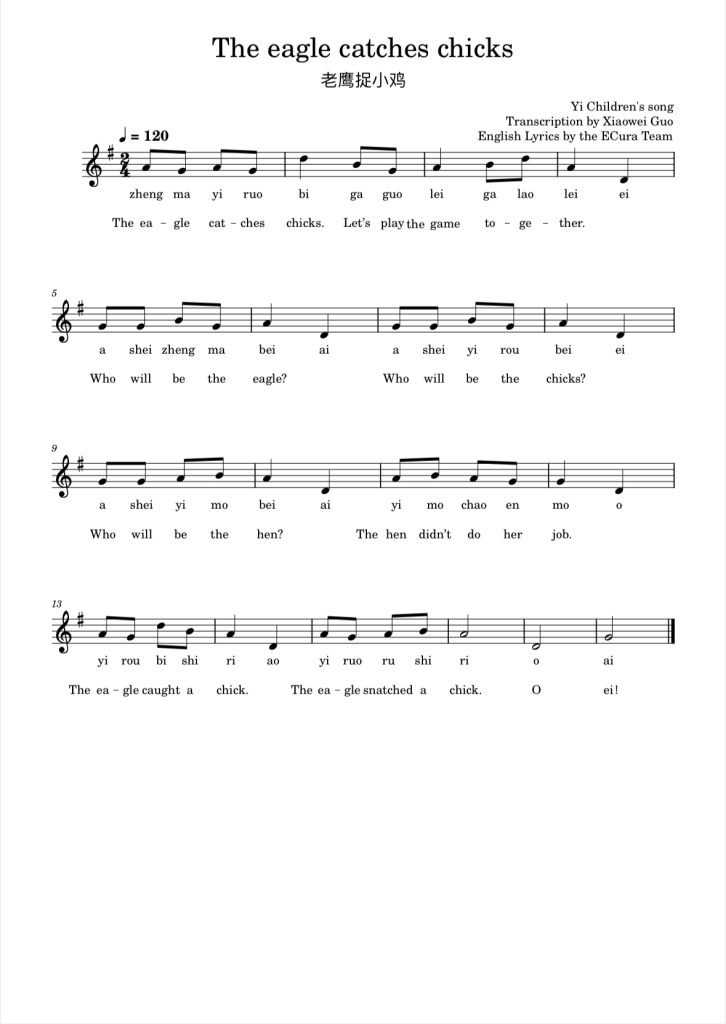
The Eagle Catches Chicks 老鹰捉小鸡
The Tune of Rain 下雨调

Creating the Sky and the Earth: The Questions and Answer 开天辟地 问和答
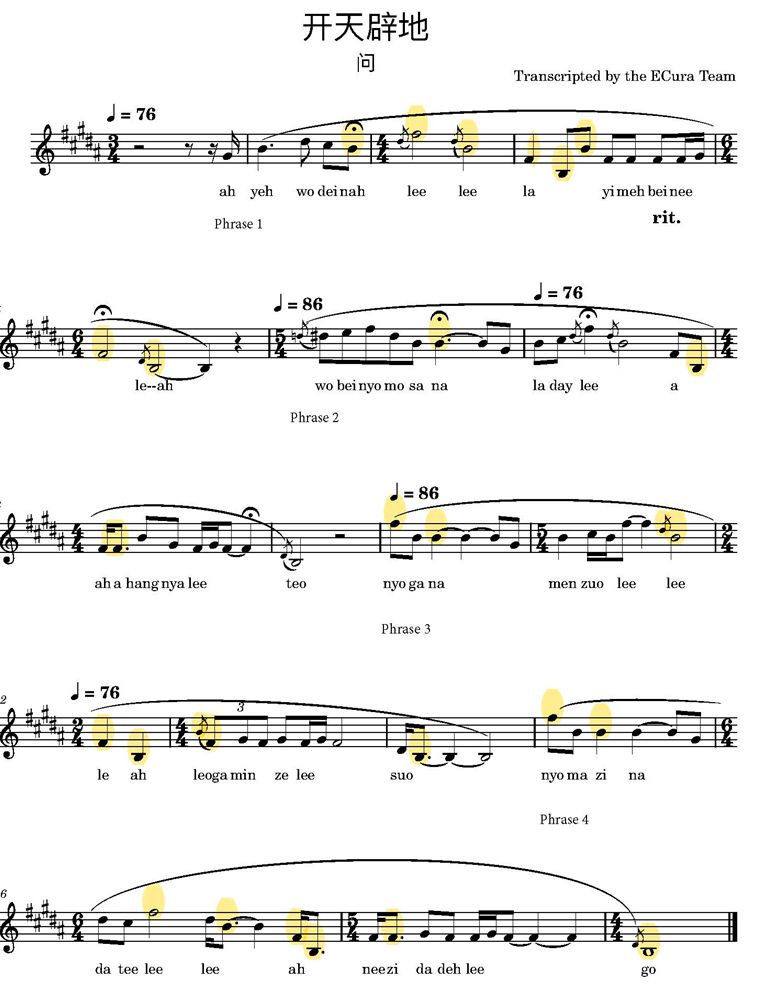
The songs “Question” (问) and “Answer” (答) form part of a grand Yi ethnic epic that explores the origins of heaven and earth through the traditional tune of Ai ga le (哎嘎嘞). Performed in a common Yi vocal style that utilizes a call-and-response format, these songs offer a rich narrative depth and cultural insight. The following are some characteristics of this type of tune.
- Rhythm and Tempo
From the use of time signatures like 3/4, 6/4, 4/4, and 2/4, it is evident that both songs are characterized by their highly freeform rhythmic structure lacking strong rhythmic sensibility. This approach allows for a more fluid and expressive delivery, akin to natural speech patterns. When dealing with such free and loose rhythms, it can be challenging to decide how to standardize the rhythmic notation. In such cases, traditional time signatures may not accurately reflect the true fluidity and expressiveness of the music. For this type of music, more flexible notation methods may be needed to capture its unique rhythmic characteristics. Some contemporary Western composers choose not to use fixed time signatures, or they use irregular time signature changes to better depict the music’s free flow. Additionally, incorporating specific performance instructions into the score, such as libero (freely) or ad libitum (at one’s discretion), can also help. Given that this is a common feature in songs from minority groups in Southwest China, designing suitable rhythmic notation for these characteristics requires further exploration.
- Mode
The primary notes used in both songs, ‘dol, re, mi, fa, sol, la’, are reminiscent of the traditional Chinese pentatonic scale. I will analyse their melody and mode using the solfège names corresponding to the Chinese scale degrees: gong (宫), shang (商), jue (角), zhi (徵), yu (羽).
- “Question” is characterized by a loose rhythm yet can be distinctly segmented into four phrases, each concluding on the tonic dol (宫), indicating a Gong mode (宫调式).
- “Answer” consists of eleven phrases. Notably, although the transcribed sheet music is in C# and C modes, the performer appears to lower the pitch by a semitone after the ninth measure, likely due to the initial pitch being set too high. Despite this adjustment, all 11 phrases consistently resolve on dol (宫), reinforcing the piece’s adherence to the 宫调式 (Gong mode), similar to the “Question” section.
- Melodic Features
- Throughout both songs, there is a prevalent use of intervals common in Yi music, such as parallel fifths and fourths, observable in measures like 3, 5, 7, and 10 of “Wen”. Besides, each musical phrase ends with an ornamentation that quickly slides from a note a third higher than the tonic down to the tonic dol (宫).
- Both “Question” and “Answer” essentially have only one main melodic line or theme. The variation within each musical phrase arises from the individual improvisations by different singers, particularly in terms of rhythm and ornamentation. However, these improvisations are all based on the foundational or main notes of the melody. To illustrate this, I highlighted the main notes of the melody in yellow in the musical score of “Question”, making it easy to recognize that, despite individual variations by the singers, the core melody remains consistent throughout both songs.
- Conclusion
The song “Question” and “Answer” features a free and fluid rhythmic structure with melodies that unfold similarly to spoken language. They utilize improvisational techniques, with specific musical intervals like parallel fifths and fourths, and are rich in decorative notes, all of which highlight the unique characteristics of Yi ethnic music. In long narrative songs like these, it’s common for Yi and other minority groups in Southwest China to repeat melodies. This practice not only makes the music more narrative-driven but also helps to preserve a recognizable musical identity, ensuring that these familiar melodies remain a vital part of the community’s collective memory.

Music notation transcribed by Yalun Yang, text written and edited by Keyi Liu
Yi Meige Musician Guo Xiaowei (郭晓炜) Creates Music Learning Videos Using ECura Database
Since March 2026, Mr. Guo Xiaowei (郭晓炜), a community collaborator with the ECura project and a Yi musician specializing in the Meige epic tradition, has been creating Yi language and music learning videos based on data from the project’s Multilingual Audio Database of Spoken and Sung Lyrics from Oral Tradition, specifically drawing on materials related to the Yi epic Meige.
Dr. Lijuan Qian, Principal Investigator of ECura, praised the initiative: “This is a bold and meaningful endeavor. I hope Mr. Guo will continue to make use of the platform and resources offered by the ECura project, allowing more local people to access and benefit from the multilingual audio database.”
Below are examples of the videos created by Mr. Guo Xiaowei (郭晓炜):
Original video by Guo Xiaowei
Text by Tingting Tang
彝族梅葛音乐家郭晓炜依托ECura数据库尝试制作音乐学习视频
2026年3月以来,ECura项目社区合作者、彝族梅葛音乐家郭晓炜先生,依托项目建设的“多语口头音乐传统音响语料库”中彝族传统史诗《梅葛》的相关数据,尝试制作配套的彝语及音乐学习视频。
项目负责人钱丽娟博士对此表示高度肯定:“这是一个大胆而富有意义的尝试。希望郭老师能持续借助ECura项目搭建的平台与资源,让更多当地民众接触并受益于这一‘多语口头音乐传统音响语料库’。”
视频原创:郭晓炜|文:唐婷婷