——The Chunwang Zhengyue Selected as County-Level Intangible Cultural Heritage
The ritual drama known as Nao Chunwang Zhengyue (闹春王正月)—also called Zhengyue Dage (正月打歌), meaning dancing in the first-Lunar-month—is one of the largest and most distinctive events held in Qifeng Village during the annual benzu(本主) deity reception. Blending multiple cultural elements, the ritual venerates Chunwang (春王), the Spring King, a seasonal deity whose title derives from the Zhouli’s Chunguan (春官), the official responsible for ritual and ceremony. This connection reflects the influence of Confucian cultural traditions. Throughout the celebration events, villagers take on various costumed roles and perform dramatic texts corresponding to their characters. One important figure, representing the divine messenger, carries a wooden plaque reading huibi (回避, in English avoid), two Chinese characters reading shengzhi (圣旨, in English sacred decree) on their back, and a gong in their hand. At dawn, they walk through the village announcing the deity’s inspection tour and marking the start of the festival. Sometimes they even ride to neighboring villages to spread the news. As a result, people from nearby settlements often come to join the celebrations—a chance to visit relatives and renew social ties.
Qifeng Village has experienced profound social changes since the 1930s. During decades of war and sweeping political campaigns, rituals associated with benzhu worship (本主崇拜) were banned. Yet these traditions were never fully erased from villagers’ memories. In the early 1960s, as China entered a period of adjustment and the shuangbai (双白, in English double hundred) cultural policy was revived, daily life stabilized. The local villagers began recalling ancestral customs such as receiving the benzu worship and celebrating the Spring King First Month, and the ritual saw a brief revival. But the return was not without incident: during one performance—featuring a mock courtroom trial—an attending county Party secretary was unexpectedly pulled into the role-play. The event was soon denounced as a resurgence of “feudal superstition” and “class retaliation,” circulated in documents across the province. During the ten years of the Cultural Revolution, campaigns against “superstition” again prohibited all benzhu worship-related activities, causing a second disappearance of the ritual. Despite these disruptions, the ritual’s roots remained alive in the collective memory of Qifeng residents.
Today, elder villagers such as Wang Bingcui (王炳翠), Zhang Zhongming (张仲明), and Yang Jifan (杨吉繁) hope to revive these traditions at an appropriate moment in history. They not only wish to restore the ritual but also to rehearse and stage selected dramatic excerpts from Spring King First Month as a Bai opera reflecting local heritage. Since March of this year, the elders have voluntarily gathered to reconstruct the full sequence and theatrical texts of the ritual from memory. Through audio recordings, video documentation, and handwritten notes, they pieced together these scattered cultural fragments. Former ECura project member Dr.Keyi Liu also joined the effort, assisting with text transcription and proofreading.
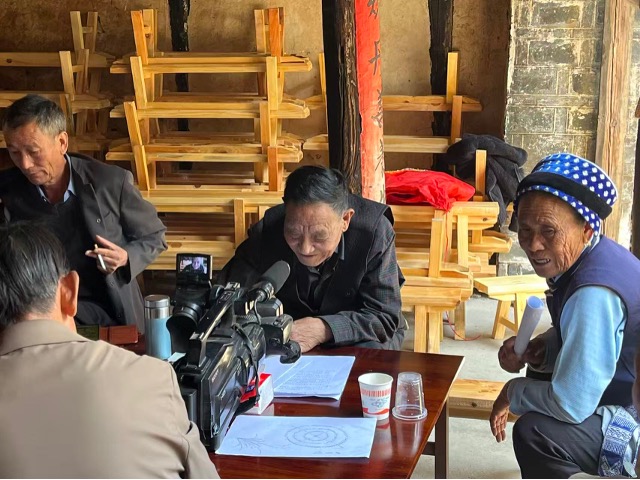
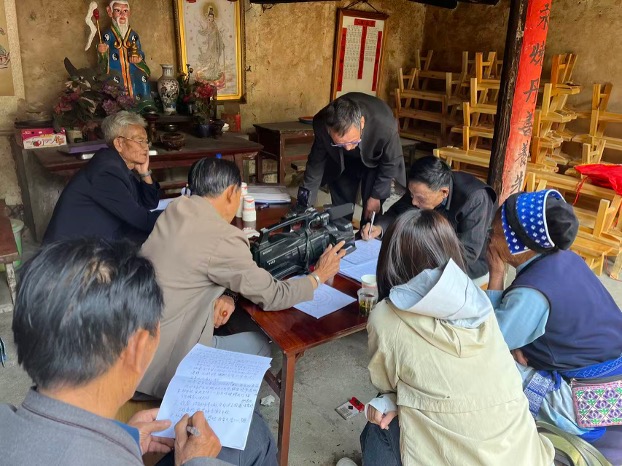
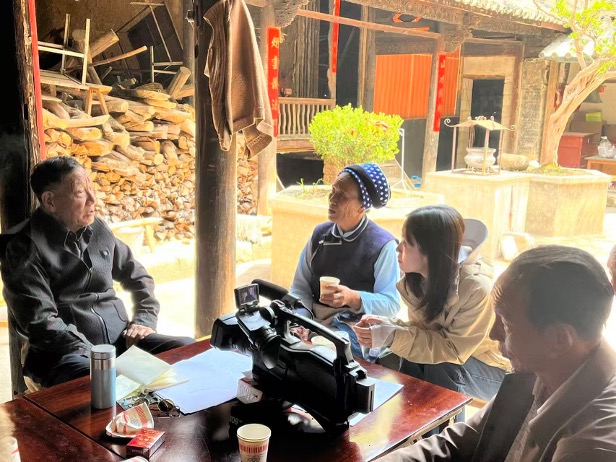
Recently, Chunwang Zhengyue (春王正月, the Spring King of the First Lunar Month) was officially inscribed on the county-level representative list of intangible cultural heritage. Overjoyed, the villagers have already begun preparing performances of their classic scenes. If all goes well, they plan to stage the piece during the Spring Festival of 2026, using this momentum to strengthen their application for city-level ICH status. The ongoing revival of these cultural practices not only fosters local cohesion and identity but also provides a valuable case for understanding social change in rural China, as well as the resilience and adaptability of traditional culture. Yet despite the elders’ deep respect and determination, they face significant challenges: reviving such traditions requires substantial human, material, and financial resources—far more than the village can easily provide.
By Keyi Liu | Translated by Tingting Tang | Photos by Keyi Liu | December 11, 2025
“春王正月” 成功入选县级非遗:村民聚力传承老戏文
闹春王正月,或称为“跳正月歌舞”(正月打歌),正是起凤村人在接本主期间举行的一项规模较大且特殊的活动。活动内容融合了多种文化元素,其中春王被视为岁首季节之神的尊称,源自《周礼》中的“春官”角色,指执掌礼仪之官,象征着儒家文化的影响。在这一系列活动中,村民扮演各式角色,并身着戏服,唱着相应符合角色的戏文。比如代表神的“发传牌”人,手持写有“回避”字样的木牌,肩背“圣旨”,手中敲锣,一大早就在村里四处传谕本主出巡的通知。他负责通知每家每户,准备迎接,并宣布闹春王正月活动开始。有时, 这位使者还会骑马到邻近村寨传谕。因此,许多上村下寨的人也赶来参加盛会,也借此机会走亲戚,联络感情。
自20世纪30年代起,起凤村便经历了社会剧烈的变迁。在那个动荡的时代背景下,由于战争及 一系列政治运动的影响,与本主崇拜相关的文化活动一度遭到禁止。然而,这并不代表本主崇拜及春王正月活动在起凤村民心中彻底消逝。20世纪60年代初,中国步入调整期,文艺复兴的“双百”方针得以重提。随着生活的逐渐稳定,村民们再次回想起祖辈流传下来的“接本主”和“闹春王正月”的习俗,于是这些传统活动得以复苏。但这次复苏并非无波折,如前所述,其中包括设立公堂审讯的游戏环节,一名到场观摩的县委书记甚至被卷入“审讯”游戏之中。因而,此次活动被贴上了封建迷信复辟及阶级报复的标签,被认为是阶级斗争的新表现,事件还被形成文件在全省通报。随后的“文革”十年,旨在根除迷信的政治运动将本主崇拜及相关文化活动再次列为禁止,导致闹春王正月活动的再次消失。
尽管在历史的某些时期,这些活动因政治运动和社会变革而遭到暂停或禁止,它们在村民心中的根基却从未消失。目前,在起凤村,像王炳翠、张仲明和杨吉繁这样的老一辈村民,希望这些传统习俗得以在适当的历史时刻复苏。他们不仅希望能够重新激活这些文化活动,并计划排练春王正月里的戏曲选段,把它们整合成一出反映村庄本土文化的白族戏剧。
今年 3 月以来,村里的老人们自发集结,凭着对往昔的珍贵记忆,合力拼凑出 “春王正月” 的完整活动流程与戏文唱词,通过录制音视频、手写等方式,将这些散落的文化碎片整理成册。前项目成员刘可意也主动参与其中,协助完成文本的梳理与校订工作。近日,“春王正月” 成功入选县级非物质文化遗产代表性项目名录。村民们欣喜之余,也已着手筹备排演其中的经典片段,计划若进展顺利,将于 2026 年春节期间正式上演,同时为申报市级非物质文化遗产积极蓄力。这些文化活动的持续和复苏,不仅会为当地社区带来凝聚力和认同感,也会为研究中国乡村社会变迁、传统文化的持续性与适应性提供宝贵的案例。遗憾的是,尽管村中老人们对传统习俗抱有深厚的敬意与复兴的渴望,但面对复兴这一传统文化所需的人力、物力和财力的巨大挑战,他们常感力不从心。
作者: 刘可意 | 照片: 刘可意 | December 11, 2025